







Private club leadership is constantly bombarded by “the next shiny thing.” Slick software startups promise instant fixes, modern interfaces, and effortless upgrades, making it tempting to jump from vendor to vendor every few years in search of a silver bullet.
So when an operational titan like The Landings Golf & Athletic Club, a premier Savannah community spanning 9 dining venues, 6 championship golf courses, and multiple pro shops, refuses to jump platforms and sticks with Northstar for 12 straight years, it isn’t out of fear of change. It’s because they understood and categorically chose to step out of the fundamental industry trap.
In July 2014, The Landings Golf & Athletic Club didn’t just buy a software vendor; they partnered with Northstar.
They stayed because they discovered a rare operational truth: off-the-shelf software will never perfectly fit a massive, multi-facility operation out of the box. You need a partner who is willing to do the heavy lifting, take on complex custom challenges, and continuously build with you as you grow.
Here is how one of America’s largest private clubs eliminated its operational friction and why their CFO considers platform-hopping the single biggest risk a club can take.
Escaping the “Dark Ages” – The High Cost of a Patchwork System
Before 2014, The Landings Golf & Athletic Club was running on a web of disconnected point solutions – software packages bolted onto one another, none of them truly talking to the next.
That is a common setup for private clubs, but at The Landings’ scale, the friction was massive. Point-of-sale data lived in isolation from the general ledger. Tee sheets operated on one platform, while dining reservations were patched in from a third-party vendor via an external website link.
The finance team bore the brunt of this fragmentation. Reconciling point-of-sale chits against the ledger meant manually exporting and moving data three times a week.
As Jesse Ruben, CFO of The Landings Golf & Athletic Club, bluntly put it: they were manually moving numbers and “praying it landed correctly.”
“Twelve years ago we were in the dark ages. I take that for granted now. It’s been so long since I’ve even thought about it.”
— Jesse Ruben, CFO, The Landings Golf & Athletic Club
When your point-of-sale, dining, golf, and accounting software exist on separate islands, your executive team is left driving in the dark. The Landings Golf & Athletic Club didn’t need another point solution slapped onto their legacy setup. They needed a single, centralized database, unified source of truth across their entire operation.
Finding the right platform, however, was only half the battle. The real test was bringing it live without causing total operational chaos.
The “Big Bang” Go-Live – Why Discipline Beats Customization on Day One
When a club managing nine dining outlets and six golf courses replaces its core tech, standard playbook calls for a slow, agonizingly phased rollout.
The Landings Golf & Athletic Club chose a far bolder path: On July 26, 2014, they executed a total “Big Bang” cutover, shutting down their legacy patchwork and bringing Northstar live across every single venue, pro shop, and entry point in a single weekend.
Working through the night, Northstar’s implementation team audited every terminal and menu. The payoff was immediate:
“Every menu was perfect. We didn’t have any blips. It was because of the prep work that our team had done with the Northstar team as one. It was truly magical stuff. For a club like ours to turn off one system and turn it on the next day with no member complaints was ridiculously successful.”
— Jesse Ruben, CFO, The Landings Golf & Athletic Club
The Secret to Flawless Execution: Day-1 Discipline
Why did the transition work when so many software launches fail? It came down to a firm operational rule Jesse set for his team: Standardize first, customize later.
- No Pre-Launch Customization: Instead of demanding heavy custom code upfront, a habit that delays launches and breaks code. Jesse instructed: “We’re buying the system, we’re not enhancing the system.”
- Baseline Operations First: Launching on the out-of-the-box platform allowed staff to master the system and stabilized core workflows immediately.
- Earned Enhancements: By mastering the standard setup first, the club created a rock-solid foundation to co-develop custom features down the road.
A smooth go-live, however, is only day one of a long partnership. The real test begins when off-the-shelf software meets unique operational challenges no existing feature can solve.
From Vendor to Co-Developer – Building What Didn’t Exist
Most software vendors sell a rigid box: you adapt your operations to their code, and if a feature doesn’t exist, you’re told to buy a third-party add-on.
Northstar took the opposite approach with The Landings Golf & Athletic Club. As baseline operations stabilized, both teams identified complex operational hurdles that out-of-the-box software simply wasn’t built to handle. Rather than forcing awkward workarounds, Northstar sat down at the table to co-develop the missing infrastructure from scratch.
1. The Club-Wide Dining Reservation Platform
At go-live, native dining reservations weren’t part of the Northstar platform, leaving the club tethered to a third-party tool linked through their website.
Within a year, The Landings and Northstar teams collaborated to spec out, design, and launch a native dining module built precisely to the club’s high-volume operational standards.
What started as a custom build for one client became the standardized dining engine powering Northstar clubs across the country.
2. Reverse-Engineering the Tee-Time Lottery
Golf presented an even tougher challenge. Most tee-sheet software operates on a simple course-preference model: members pick a specific course first, then fit their schedule to open times.
The Landings Golf & Athletic Club’s membership works in exact reverse:
- Time-First Priority: With 6 courses, members prioritize the time slot first, taking whichever course is open.
- Massive Group Bookings: Member groups routinely run 12 to 15 foursomes deep on a single, linked reservation.
Standard lottery algorithms collapsed under that demand. Early builds were tough, but instead of walking away, both teams instituted weekly working sessions, logging issues, tweaking code, and refining logic line-by-line until support tickets settled to zero.
The lesson wasn’t that the initial software was perfect out of the box; it was that the partnership stayed in the trenches until it was.
The Quiet Payoff – What 1 Unified Database Changes
Twelve years in, the real power of running a single database across an enterprise is something leadership at The Landings Golf & Athletic Club takes completely for granted, which is precisely the point.
When your tech stack works silently in the background, administrative headaches disappear, and your executive team can focus entirely on growth.
“I can go into a chit and see the journal entry that chit generated. Twelve years ago, we were in the dark ages. I take that for granted now. It’s been so long since I’ve even thought about it.”
— Jesse Ruben, CFO, The Landings Golf & Athletic Club
The Operational Shift: Then vs. Now
| Operational Area | Legacy Patchwork (Pre-2014) | Unified Northstar Platform (Today) |
| Financial Reconciliation | Manual data transfer 3x a week; “praying it landed correctly.” | Every check closes to the GL overnight; instant morning revenue visibility. |
| Member Booking Channel | Fragmented website links for dining and golf. | ~90% of all dining & tee times booked directly in the member app. |
| High-Volume Kitchen Ops | Paper tickets piling up at busy venues; order drop-offs. | Digital Kitchen Display Systems (KDS) managing 700+ tickets/day at fast – casual outlets. |
What’s Possible When Everything Lives in One System
Scenario A: Peak Saturday

It’s 1:30 PM on a sweltering July Saturday at the cabana bar. The pool deck is packed, and orders are flooding in from every angle.
Behind the counter, the air is thick with friction. The register runs on an isolated POS system that doesn’t talk to the club’s central ledger or the member database. Staff are frantically pounding buttons on a sticky screen while paper ticket printers choke out endless strips of paper.
Within twenty minutes, the ticket spike at the expo station is overflowing. A humid gust of wind blows two orders onto the wet line floor, rendering them unreadable. A kitchen runner accidentally pulls an order out of sequence because there is no visual priority routing, leaving a high-tier board member waiting 40 minutes for a simple burger while orders behind theirs get served first.
Meanwhile, a member tries to charge lunch to their account, but because the software isn’t synced in real time, the server has to manually look up their account number on a laminated printout behind the bar.
By 4:00 PM, the kitchen has dropped five orders, ticket times are pushing an hour, and the staff is completely fried. On Monday morning, the finance team will spend three hours manually cross-referencing smeared paper chits against ledger sheets, hoping the numbers somehow balance out.
Scenario B: Peak Saturday with Northstar
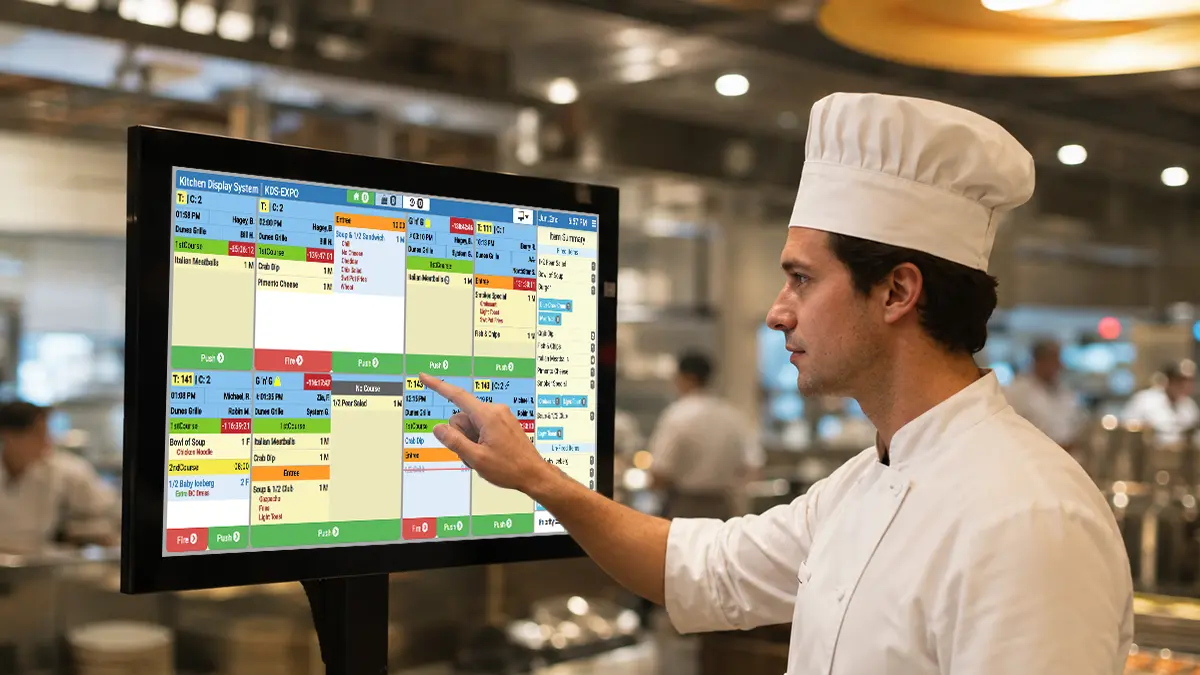
Now, jump over to The Deck, where the sun is just as hot, and the pool is just as crowded. The venue is running through over 700 tickets in a single afternoon shift.
No paper printers are screaming in the heat. There are no wet, unreadable tickets blowing across the pass, and no manual account lookups.
Instead, a member taps their phone from a lounge chair poolside, ordering lunch directly through the club’s mobile app. That order, alongside orders punched in at the counter, routes instantly and silently onto digital Kitchen Display Systems (KDS) screens inside the kitchen.
Orders are automatically prioritized and color-coded by time and station. The line cooks see exactly what needs to fire and when, keeping ticket times locked under ten minutes despite the massive volume. The member’s profile, dietary preferences, and billing account are already verified by the central database.
When the order is served, the ticket closes automatically. That night, while the staff heads home, every single transaction posts directly to the General Ledger overnight.
By Sunday morning, the CFO opens his laptop to find complete, error-free revenue visibility across the entire venue without anyone touching a spreadsheet, moving data by hand, or fixing a single lost check.
The CFO’s Warning: The Hidden Cost of “Platform Hopping”
In an industry flooded with new software startups promising quick fixes and modern interfaces, it can be tempting to treat technology like a commodity, switching vendors every few years whenever a new feature catches your eye.
Jesse Ruben offers a direct, candid warning to CFOs, General Managers, and Board Members considering that path:
“Bumping around from platform to platform at a club like ours is dangerous. It’s all about the data and the shape of the data. As we’ve grown our needs, Northstar has generally been able to keep up. Switching from group to group to group is a huge risk to your operation, and it can lead to real burnout.”
When you jump from platform to platform, you are corrupting historical financial records, forcing your team to re-learn basic workflows, and resetting your operational intelligence back to zero. The real value of a 12-year technology partnership is the accumulated operational context.
When The Landings Golf & Athletic Club contacts Northstar support today, they aren’t speaking to a representative who needs the club’s massive 9-venue scale re-explained to them. They are working with a team that knows their history, understands their database, and can solve complex challenges in minutes rather than months.
A Partnership Built to Last
Enterprise software isn’t defined by a shiny sales demo or a list of out-of-the-box features. It is forged in the trenches, during high-volume holiday rushes, complex custom builds, and seamless go-live weekends that keep your club running without a hitch.
Twelve years after pulling off a legendary, single-weekend system cutover, The Landings Golf & Athletic Club is actively shaping Northstar’s playbook. By choosing a single, unified database and a technology partner willing to do the heavy lifting alongside them, they turned a fragile web of point solutions into a quiet, future-proof operational engine.
If you are tired of managing your club through fragmented systems, manual ledger reconciliations, and constant vendor switching, it’s time to stop looking for quick patches and start building a real technology foundation.
Want to be part of the Northstar’s Club Community? – Request a Demo Now