







Ask any F&B manager at a private club what their single biggest daily operational frustration is, and the answer rarely involves the food itself. It’s almost always the system behind it or the lack of one. Charges that don’t post correctly. Allergy notes that don’t make it to the kitchen. A tableside ordering process that still involves three trips to a POS terminal across the room. A billing cycle that requires manual reconciliation at the end of every shift.
These aren’t problems caused by bad staff or poor management. They’re symptoms of the wrong tool. And in 2026, with member expectations at an all-time high and F&B pressure more acute than ever, using the wrong F&B POS system is a decision that costs clubs more than most GMs have time to calculate.
This blog is for F&B directors, GMs, and operations teams who are either evaluating their first club-specific POS solution or finally ready to move beyond a restaurant system that was never built for how private clubs actually run.
The F&B Pressure Private Clubs Are Navigating Right Now
Food and beverage have always been a complex corner of club operations. But the numbers tell a more specific story about just how much is riding on getting it right.
According to Club benchmarking F&B reports:
- 75% of private clubs run F&B at a net loss
- ~30% of total club revenue comes from F&B
- Near-zero gross profit contribution in most cases
That’s a structural reality of the club model. F&B is not designed to be a high-margin business. It exists as a member amenity, largely supported through dues rather than standalone profitability. But that reality has an important implication – every inefficiency in F&B carries an outsized financial impact.
- A billing error is a lost margin in an already thin operation.
- A remade dish is a compounding cost.
- Manual reconciliation is an expensive operational drag.
The technology clubs deploy in their dining rooms can’t fix the economics of private club F&B, but it can stop making a difficult operation harder than it needs to be. A purpose-built club dining POS facilitates operational precision.
Why Restaurant POS Systems Fall Short in a Club Environment?
Walk into almost any private club that’s struggling with its F&B operation, and you’ll find the same thing: a restaurant POS system trying to manage a club environment. Restaurant POS systems are designed for a fundamentally different operating model.
| Restaurant Functioning | Club Functioning |
| Anonymous, one-time diners | Known members with rich profiles |
| Payment at the end of each meal | Charges posted to member accounts |
| Static pricing | Tier-based pricing, discounts, and minimums |
| Single-visit context | Persistent preferences (allergies, history) |
| One outlet at a time | Multi-outlet operations (dining, bar, pool, events) |
| Simple billing flows | Monthly statements with correct categorization |
A general restaurant POS can be configured to handle fragments of this. But not all of it together, in real time, and without friction. Clubs that use them typically end up with a POS on one system, member data on another, billing on a third, and someone in accounting manually connecting the dots every night. This is a workaround that costs time, manual effort, and leaves ample scope for manual error.
What Club-Specific F&B POS Software Actually Looks Like
The difference between a restaurant POS and a genuine club dining POS isn’t always visible in the feature list. It shows up in how those features connect and what they know.
 Member-Centric Order Management
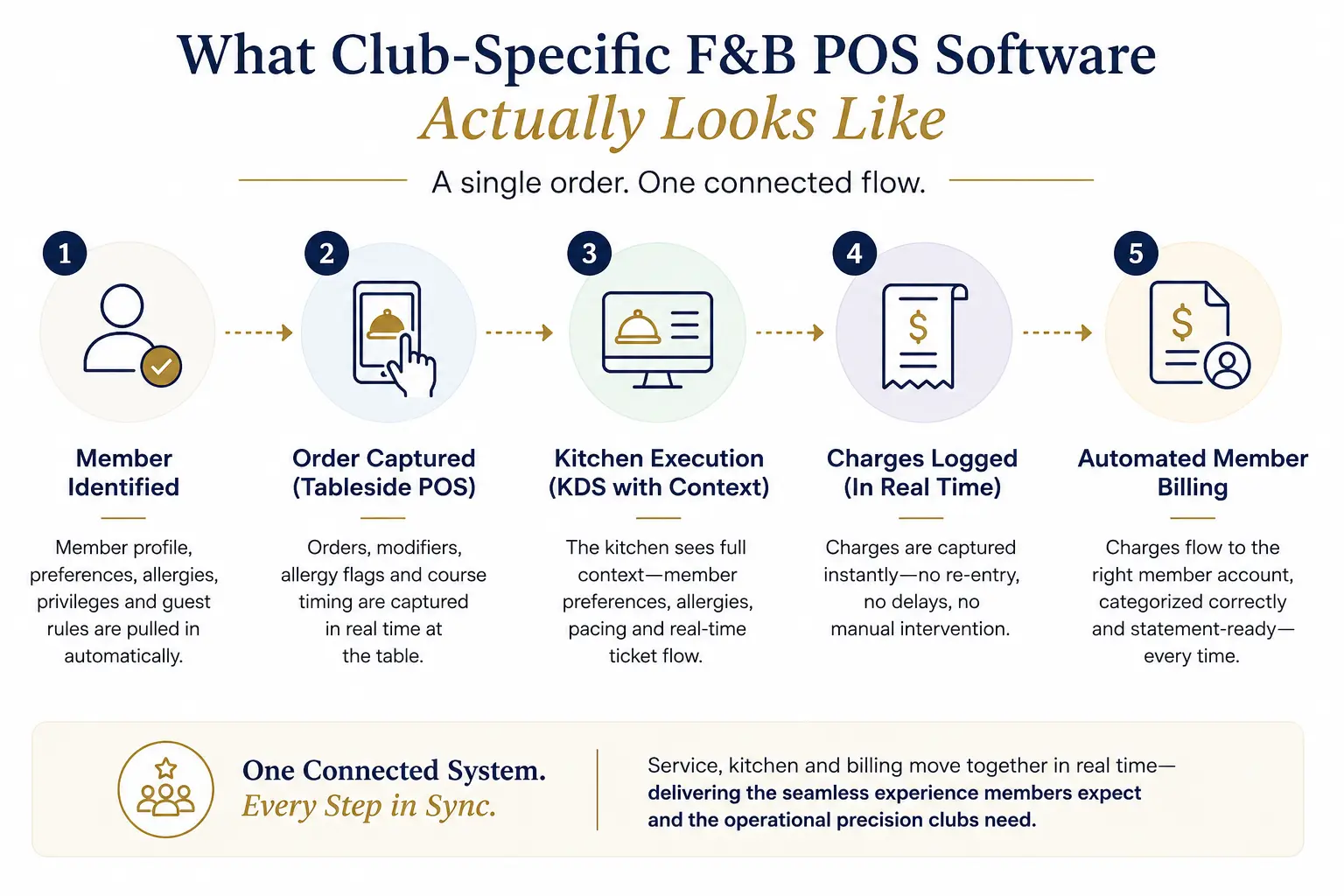
In a club dining context, every order starts with a member identity, not a table number. The server knows who they’re serving before the order is placed. A club F&B POS built correctly pulls that member’s profile at the point of order, including dietary restrictions, preferred seating, minimum balance status, guest authorization rules, and any notes from previous visits automatically.
Restaurants that use advanced automation report a 20–25% increase in staff productivity, primarily because staff spend less time on administrative tasks and more time on service.
Tableside POS System: Where the Experience Actually Begins
When a server takes an order on a handheld device at the table, the order reaches the kitchen in seconds, not after the server walks back to a fixed terminal, enters the order, and returns. Modifiers, allergy flags, and course timing preferences travel with the order. Member billing starts the moment the order is placed.
Club technology data consistently shows that pairing a tableside POS with a kitchen display system reduces average order-to-delivery times by 4 to 8 minutes per table, a meaningful difference in a dining room where members expect attentive, seamless service.
Kitchen Display System Integration
A kitchen display system for clubs is only as useful as the information it receives. If the KDS is connected to a club management platform, it gets member preferences, allergy flags, table sequence, course timing, and a real-time view of every active ticket in the building, all without anyone re-entering a thing.
Courses fire at the right time. Allergy modifications are visible at every prep station. The expo manager sees the full dining room, not just individual stations. After service, ticket time data feeds directly into management reporting, so the patterns become visible.
Member Billing POS: Closing the Loop on Charges
In a club, every meal ends with a charge to an account, and that charge needs to post correctly, be categorized correctly, be posted to the right member, reflect the right minimums, and have the right tax treatment across potentially multiple F&B outlets.
A member billing POS built for clubs handles all of that automatically. Charges flow from the point of order to the member’s statement without manual intervention. Split charges between members and guests, minimum balance tracking, and reciprocal billing for affiliated club members are handled in the system, not by someone in accounting at the end of the night.
Read more about how kitchen display systems help the kitchen staff in identifying exactly what needs attention, in what order, without anyone having to say a word – Kitchen Display Systems for Private Clubs – A Complete Guide. Also check why a tabletop POS system is essential for clubs
How Current Platforms Stack Up and Where the Gaps Are
Most clubs don’t choose their F&B POS in a vacuum; they inherit it, adapt it, or work around it. Across the industry, three distinct approaches have emerged. Each solves part of the problem. None, until recently, solved it completely. Here is a platform comparison:
| Category | Strengths | Limitations in a Club Context |
| Restaurant-Adapted Systems | Mature POS capabilities, fast UI, widely used in hospitality | Require integrations for member billing and pricing; workflows break under complexity; high manual intervention |
| Legacy Club Software POS Modules | Deep accounting integration; strong financial control | Outdated interfaces; limited mobility; not designed for tableside or real-time service environments |
| Modern Integrated Club F&B Platforms | Unified system across POS, KDS, billing, and member data; real-time visibility | Still evolving category; requires upfront transition and process change |
All forms of platforms have their merits and challenges:
You can assess the gaps by understanding the root of where the tools are inherited from and the beliefs they were built on. For instance, restaurant-adapted systems seem to perform well at the surface level. But they are not built for integrations, which are the core of a club environment. Member billing, account charging, membership-aware pricing, and personalized customer service typically require third-party integrations that don’t always hold up under volume. Staff managing these systems often become experts in bridging the gap manually.
Legacy club software POS:
On the other hand, was built in a pre-mobile era. They carry deep accounting integration. The trade-off is interface: these systems were designed before tableside ordering, mobile POS, and cloud-native architecture were considerations. Users describe them as reliable but slow, feature-rich in the back office and cumbersome on the floor.
Modern integrated club F&B platforms:
Try to close this gap by treating F&B as part of a connected ecosystem. They are built on newer integrated platforms that can handle F&B POS, tableside ordering, kitchen display, dining reservations, member billing, and management reporting as connected modules on a single database.
By 2026, cloud deployments will account for over 56% of the restaurant POS market, and modern club platforms reflect that shift, with real-time visibility across all F&B outlets from any device.
The Features That Separate Good from Genuinely Useful
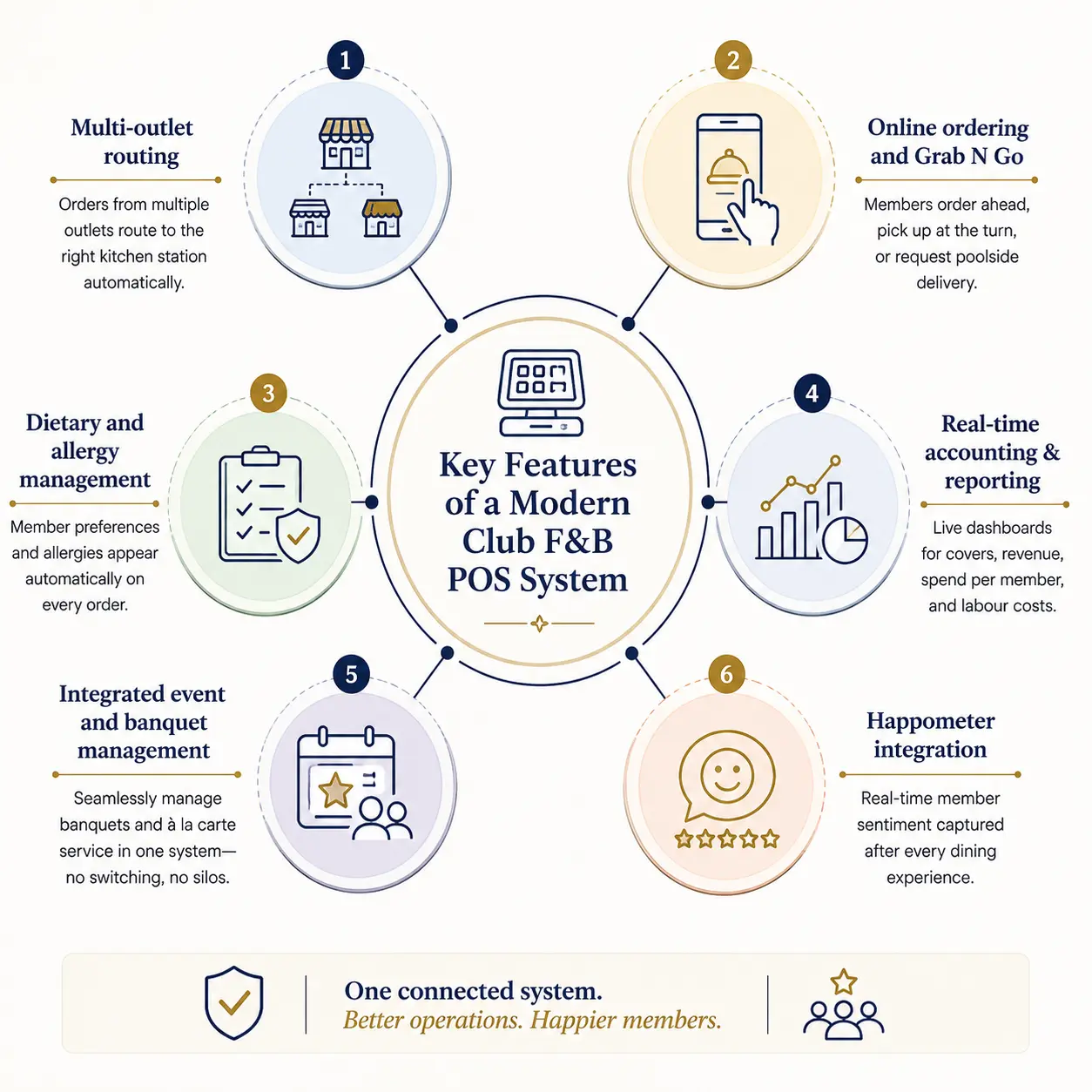
- Multi-outlet routing: Orders from the dining room, bar, pool, and event space route to the correct kitchen station automatically, eliminating manual ticket handling and reducing order errors.
- Online ordering and Grab N Go: Members order ahead, pick up at the turn, or request poolside delivery.
- Dietary and allergy management at the ticket level: Member preferences appear automatically on every order, not re-entered on each visit. With food allergy incidents rising globally, systems that surface this data in real time significantly reduce risk while improving member trust and personalization.
- Real-time management reporting: Cover counts, revenue by outlet, average spend per member, and labor cost per shift in a live dashboard. Operators using real-time reporting typically improve decision-making speed, particularly in staffing and inventory management.
- Integrated event and banquet management: Handles both banquet and à la carte service without switching systems. This is critical in clubs, where events actively contribute to F&B revenue. Operational silos often lead to missed revenue capture or billing inconsistencies.
- Happometer integration: Real-time member sentiment is captured after every dining experience, connected directly to the same platform. Experience-focused operators that actively track and respond to feedback see measurable improvements in retention and spend per member over time.
The Questions Worth Asking Before You Commit
Investing in an F&B POS platform is a long-term commitment. Frequent changes result in time-consuming implementation, repeated staff training, and customer data loss. So, it’s essential to make the right decision after evaluating all the aspects, features, and requirements. Here are a few questions that you can ask yourself to evaluate your business requirements.
Where are your current F&B billing errors coming from?
Manual entry between systems, misapplied minimums, and guest charge disputes all point to specific feature gaps worth testing.
How does the system handle your guest policy?
Guest billing, guest frequency limits, and member accompaniment requirements should be enforced at the POS level, not caught after the fact.
Does the tableside solution work on your network?
Outdoor dining areas, pool decks, and halfway houses create coverage challenges that a demo in a conference room won’t reveal.
How does F&B data reach your accounting system?
Ask whether daily charge totals, cover counts, and cost-of-goods data flow automatically or require export and import.
What does the go-live process look like for the kitchen team?
F&B staff have less tolerance for system disruption than almost any other department. Understand the training plan and the support available during the first few weeks of live service.
Where does Northstar’s F&B POS Stand?
Northstar’s Food & Beverage module is built as part of the Nexus platform, the same platform that handles membership, accounting, tee times, events, and member communications. That matters because the F&B POS isn’t an integration. It’s a module drawing from the same member database as everything else.
It starts before the member even walks in.
A reservation made through ClubNow already carries their preferences, allergy notes, account status, and guest permissions; quietly setting the stage.
At the table, the server simply opens the order on a tableside device. Everything they need is already there.
The order moves seamlessly to the kitchen display system, complete with member context and preferences.
And when the experience ends, billing takes care of itself. Charges are posted automatically, correctly categorized, without anyone stepping in.
The F&B suite within Northstar includes Dining Reservations, Tableside POS, Grab N Go, F&B POS, and Kitchen Display System, all connected, all drawing from the same data. Management reporting surfaces in the same analytics & reporting dashboard as membership trends, tee time utilization, and event performance, giving GMs and F&B directors a single view of the whole operation.
For clubs already running Northstar for membership or golf, adding F&B isn’t an implementation; it’s activating modules that already know who your members are.
What Clubs Are Saying
The clubs that have made the switch consistently point to the same outcomes: fewer billing errors, faster service, and staff who spend less time managing the system and more time managing the member experience.
“We’ve been using Northstar for six years now. It brought all of our club’s functions together under one easy-to-use umbrella. The Nexus upgrade is helping us enhance member engagement with faster reservations and food ordering. Plus, having a dedicated support team we know by name has made a real difference for our staff ”
— Jennifer Garrett, Assistant Manager, Princess Anne Country Club
Hear from Rachel Diehl, Controller & Systems Manager at Castle Pines Golf Club
Hear from Rachel Diehl, Controller & Systems Manager at Castle Pines Golf Club, about how amazing Northstar has been in providing a single system that connects rooms, tee times, food & beverage, inventory, and accounting seamlessly, simplifying club operations.
The Bottom Line
Private club F&B is operationally complex, financially sensitive, and member-facing in a way that commercial restaurants simply aren’t. The right F&B POS system won’t change the underlying economics of club dining, but it will stop adding unnecessary cost, friction, and error to an operation that already runs on thin margins.
The clubs getting this right in 2026 aren’t those with the biggest technology budgets. They’re the ones that chose a platform built for how club F&B actually works, member-aware, integrated from reservation through to statement, and accessible enough that the kitchen team, the servers, and the accounting department all actually use it.
“If your current system requires anyone to manually move data between departments at the end of a service, it’s costing you more than the license fee.”
Ready to see Northstar’s F&B POS in action? Book a Demo Now