








Private club leadership faces a delicate balancing act when upgrading core technology. In a world where software vendors frequently promise “frictionless” migration and overnight fixes, stepping away from a system your team has relied on for over a decade feels less like an upgrade and more like a high-stakes operational leap.
When you happen to be the Tokyo American Club, a Platinum Club of the World ranking among the top five percent of private clubs globally, with more than 12,500 members, 400+ staff, and two sprawling clubhouses, the stakes are magnified. As the only institution of its kind in Japan, there is no second option for members who want this experience in Tokyo. System downtime, corrupted financial ledgers, or compromised member data simply aren’t options.
The Operational Pressure of Zero Error
In major international hubs like Hong Kong or Singapore, ex-pats and global executives choose between several premier private clubs. In Tokyo, there is only one.
That singularity creates a unique operational pressure for General Manager Dustin McAvoy and Financial Controller Don Suranga. If technology fails at a standard club, members complain. If technology fails at Tokyo American Club, it disrupts the social and diplomatic anchor for over 12,500 international members across 50+ nations.
When their decade-old legacy platform reached vendor end-of-life, leadership couldn’t just shop for a standard hospitality POS. They had to solve for two non-negotiable enterprise constraints:
- Enterprise PII Data Security: Hosting sensitive personal, diplomatic, and corporate data for thousands of international families required a database engineered for strict data protection as its core function. Not an add-on module.
- Board & Ex-Pat Governance: With a majority North American membership base. The Board required a platform with proven trust and market dominance across North America’s top-tier private clubs.
“The biggest thing is membership, because it’s PII data, so secure, and handling the membership database is the biggest concern we had. And we heard that in North America, most clubs are using Northstar, and majority of our members are from America. So the board strongly favored going to something most clubs are using.”
— Don Suranga, Financial Controller
Ultimately, for an institution as singular as the Tokyo American Club, choosing the right technology partner was far more than a routine software upgrade. It was a strategic imperative essential to safeguarding member trust and preserving the integrity of a vital diplomatic and social pillar.
Executing a Tech Transition in Japan
Replacing a core system after ten years is notoriously difficult in any enterprise. Doing so in Japan, navigating specific regulatory environments, language dynamics, and a 400-person workforce deeply accustomed to fixed daily routines requires an entirely different implementation philosophy.
Instead of rushing to hit an arbitrary June launch date, leadership made a deliberate executive call: they delayed go-live to clean and reformat ten years of legacy data properly. They treated database hygiene as a non-negotiable investment in long-term operational stability.
The Floor-Level Strategy With An Embedded Presence
When go-live arrived, the turning point wasn’t a manual or a remote video portal. It was the physical placement of Northstar’s implementation manager.
Rather than hiding in a back office or managing via email, the project manager embedded himself directly into the daily life of the club. He set up his workspace at reception counters, near the pool deck, and in common staff corridors.
“He started to become our staff. I felt like, oh, he’s really connected with the staff. And then the staff also started freely commenting to him and asking for support, so we don’t need to be so directly involved in solving the issues. That was really helpful for upper management.”
— Don Suranga, Financial Controller
By becoming a visible, approachable presence on the floor, frontline employees asked questions and resolved operational friction in real time. This bottom-up adoption model eliminated the need to route every minor inquiry up through executive management, building staff confidence across two clubhouses.
Unlocking 24 Hours of Stolen Bandwidth
For Financial Controller Don Suranga, the true measure of an enterprise database isn’t found in flashy front-end features; it is measured in processing velocity and audit control.
It’s just three days before month-end. In the old system, the finance team would watch the server progress bar with bated breath, praying that a power flicker wouldn’t force them to restart the entire 24-hour cycle. One minor network glitch didn’t just mean an IT headache; it meant a potential sleepless weekend for the club accounting staff, manually reconciling data because the system had timed out.
Under the legacy system, end-of-month member billing was an exhausting operational bottleneck. The finance team had to dedicate an entire computer terminal for 24 continuous hours solely to run the billing batch. For a full day and night, that hardware was unusable, while staff monitored the run to ensure power blips or system freezes didn’t corrupt thousands of international member statements.
On Northstar, that entire 24-hour processing marathon was compressed into 30 to 40 minutes.
Cutting Reporting Time from 14 Days to 5
That speed created a compounding effect across executive decision-making.
Previously, closing monthly financial statements took 12 to 14 working days, pushing financial reporting deep into the following month. By the time General Manager Dustin McAvoy and the Board received monthly statements, they were reviewing historical data rather than managing active operations.
On Northstar, the finance team cut the monthly close timeline to just 5 working days.
“The time it took for our monthly financials before Northstar, we’ve cut in half, if not more. We’re at five working days now, and it used to be 14 or 12. Our board is receiving that faster and feels much more like they have a finger on the pulse.”
— Dustin McAvoy, General Manager
Closing the books in five days gives executive leadership and the Board immediate, real-time financial visibility, transforming financial reviews from a backward-looking exercise into a strategic tool.
| Metric | Before Northstar | With Northstar |
|---|---|---|
| Monthly Financial Closing | 12–14 days | 5 days |
| Member Billing Processing | 24 hours | 30–40 minutes |
Blending Digital Innovation with Traditional Service
Modernizing a 12,500-member community requires balancing the demands of tech-savvy younger executives along with long-standing members who value traditional club touchpoints.
Rather than forcing an all-digital mandate, Tokyo American Club leveraged Northstar to elevate digital convenience while deliberately protecting print heritage:
Picture a member, Sarah, on her morning commute. In the past, she would have had to call the front desk to confirm her tennis court reservation, waiting to hear if it was available. Today, she opens the club member app, books the court in two taps, and receives an instant push notification confirming her spot. Meanwhile, in the clubhouse library, a long-time member who prefers traditional service is reading the physical copy of the club magazine, enjoying the same level of white-glove attention.
The club hasn’t replaced the human touch; it has simply amplified it with digital convenience.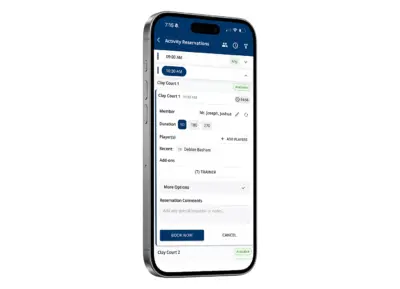
- The Mobile-First Shift: The club launched a native mobile app featuring push notifications, personalized event feeds, and direct mobile check-closing. Mobile booking quickly became the primary engagement channel for thousands of members.
- Preserving Print Heritage: Recognizing the diverse preferences of its international membership, the club intentionally maintained its physical print magazine and optional in-house paper billing statements.
By pairing modern digital touchpoints with traditional preferences. The club modernized its operational infrastructure without alienating any segment of its membership.
A Century of Excellence: Building the Next Operational Horizon
As Tokyo American Club approaches its 100th anniversary in 2028, leadership is already looking toward the next phase of its digital roadmap. With core club accounting, POS, and membership systems operating smoothly, the club is onboarding its first-ever CFO. This to transition purchasing and procurement off manual spreadsheets and fully onto the platform, alongside deeper predictive lead-tracking for membership tours.
Reflecting on the transition, General Manager Dustin McAvoy emphasizes that overcoming the initial fear of change is the real catalyst for long-term operational strength:
“I would always recommend advancing technology and efficiencies and not being afraid of change. The investment you make pays itself off tenfold over time, but you have to make that leap. You don’t have to do it for everything all at once. You can start with one piece to get your foot in the door.”
— Dustin McAvoy, General Manager
For an institution with a century-long legacy, technology isn’t about chasing short-term software trends. It is about establishing a secure, agile operational foundation capable of supporting world-class service for the next 100 years.
Want to see how Northstar can help your club modernize with confidence. Schedule your personalized demo.