







If you’re running a private club today and your accounting team works in one system, your F&B staff operates in another, your membership team lives in a spreadsheet, and yet another vendor manages your tee sheet, you’re not alone. A patchwork of disconnected tools stitches together a large number of clubs across the country. And most of them don’t realize how much that patchwork is actually costing them.
This isn’t just a technology problem. It’s an operational, financial, and member experience problem, one that quietly drains revenue, burns out staff, and erodes the very service quality that members pay premium prices to expect.
Let’s break down exactly what’s happening, what it’s costing, and what modern all-in-one club management looks like when it’s done right.
What “Fragmented Club Software” Actually Means?
Fragmented club software is what happens when a club builds its tech stack department by department, often choosing “best-in-class” tools for each function independently — one for accounting, one for reservations, one for golf operations, one for POS, perhaps a separate CRM for membership, and so on.
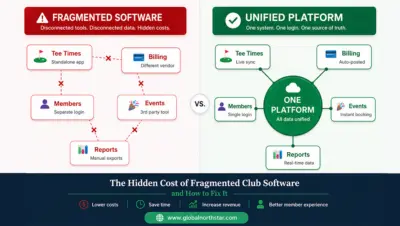
On the surface, this seems reasonable. Each tool does its job well in isolation. But the moment you need those systems to talk to each other, when you need to reconcile an F&B charge against a member’s account, or pull a unified report across departments, or send a targeted communication based on member behavior, everything breaks down.
The result: club data silos. Information trapped inside separate systems that don’t sync, don’t share, and don’t scale.
The Real Cost of Disconnected Systems: In Numbers
Here’s the thing about fragmented software: the cost is real, measurable, and larger than most club leaders expect.
Research from integrate.io reveals that data silos cost organizations an average of $7.8 million annually in lost productivity, with employees wasting up to 12 hours per week searching for information across disconnected systems. That’s nearly a third of the standard workweek, consumed not by productive work, but by navigating a fractured information landscape.
According to a Gartner analysis cited by industry researchers, data silos cost organizations $12.9 million per year on average, driven largely by poor decision-making stemming from unreliable, non-unified data.
And at the enterprise level, the scale compounds: Fortune 500 companies lose a combined $31.5 billion per year from failing to share knowledge across internal teams, a figure that reflects duplicated projects, missed opportunities, and conflicting strategies stemming directly from fragmented architecture.
For clubs, while the absolute dollar figures may differ in scale, the proportional pain is just as real. Consider what fragmented systems mean on a practical day-to-day level:
- Your GM can’t pull a single dashboard showing revenue across golf, F&B, and membership in real time.
- Your Finance Director spends hours manually reconciling data across systems that should reconcile automatically.
- Your Membership Director has no visibility into which members are disengaging before they churn.
- Your IT team is stuck managing vendor relationships, integration patches, and API failures instead of driving innovation.
This isn’t operational inefficiency. It’s compounding strategic risk.
Why do clubs end up fragmented in the first place?
The pattern is predictable. A club grows, adds a service, finds a tool that “works well” for that department, and moves on. Over years, the tech stack becomes a layered collection of legacy decisions. Each system made sense at the given point of time. But together they create a management nightmare.
There’s also a psychological and operational hurdle. Switching costs feel large; staying costs feel invisible. The monthly invoice for each tool is small. What never appears on an invoice is the time staff lose to manual data entry, the reporting errors that lead to bad decisions, or the member who left because their experience felt fragmented and impersonal.
A 2025 Dataversity survey found that 68% of organizations cite data silos as their top concern, up 7% from the previous year. The problem isn’t shrinking. It’s growing because the number of tools available keeps expanding, and the clubs keep adding them.
The Member Experience toll nobody talks about:
The operational cost of fragmented club software is significant. But the member experience toll may be the most damaging of all and the hardest to quantify.
Here’s what members actually experience when a club runs on disconnected systems:
- A member books a tennis lesson, but the charge doesn’t appear on their monthly statement correctly.
- A dining reservation shows up on the restaurant’s system but isn’t reflected in the member portal.
- Staff at the front desk can’t pull up a member’s full history because it lives in a different system they don’t have access to.
- Marketing sends a blanket email about a golf promotion to members who have never played golf at the club.
None of these are individually catastrophic. But together, they communicate something to members: this club doesn’t really know me. And in an environment where members are paying premium initiation fees and annual dues, that feeling is dangerous.
Research from Bain & Company found that 68% of luxury consumers expect brands to offer personalized experiences that reflect their history and preferences. Private clubs, by definition, serve that exact consumer. Fragmented software makes personalization impossible.
Meanwhile, industry data from Private Club Marketing shows that when brands offer personalized experiences, 80% of consumers are more likely to make a purchase. 75% of membership directors still operate without proper CRM systems or automated marketing campaigns, even though the average major membership decision requires 7–9 touchpoints before a prospect commits. The operational gap between what members expect and what fragmented systems can deliver is widening.
How Clubs with Integrated Software are pulling ahead?
The clubs moving fastest right now share one characteristic: they’ve stopped treating their software as a collection of departmental tools and started treating it as a unified operating system.
According to Kopplin Kuebler & Wallace’s industry analysis, technology integration is no longer a premium. It’s a critical requirement for member recruitment and retention. The clubs that are winning in 2025 and 2026 are the ones using advanced data analytics to identify member preferences at a granular level, forecast usage behavior, and deliver individualized communications and experiences at scale.
None of that is possible with fragmented systems. All of it becomes standard operating procedure with a unified club platform.
When your accounting, membership, golf, F&B, POS, reservations, and reporting all run from a single database, the benefits aren’t additive; they’re multiplicative:
- Real-time reporting across every department without a single manual export.
- Consistent member data that every team member sees the same way, the moment it changes.
- Automated workflows that trigger across departments — a new member joins and immediately appears in F&B, golf, and communications systems.
- Personalized outreach based on actual behavior, not guesswork.
- Finance reconciliation that happens automatically, not at month-end after hours of manual cross-referencing.
The “Best-in-Class” Myth and Why it’s failing clubs?
Many clubs still operate on the belief that the best approach is to pick the best tool for each department. The strongest accounting platform, the most popular tee sheet, the most feature-rich POS, and connect them with integrations.
The problem is that integrations are inherently fragile. They break when vendors update APIs. They require maintenance. They introduce data latency. And they require someone on the team, usually IT, to manage them continuously.
Some of the more established club software platforms on the market have taken this multi-vendor approach. They’ve built partnerships and offer “integrations” between different modules. But an integration between two separate systems is fundamentally different from a single, unified database. Data still has to travel between systems. Conflicts still emerge. Reconciliation is still required.
The result for clubs: staff members often become the unofficial “integration layer”; manually moving data between tools, fixing sync errors, and building their own workarounds. This is the hidden labor cost nobody accounts for when signing software contracts.
What real Club Software consolidation looks like?
True club software consolidation means replacing the patchwork with a single platform; one database, one login, one source of truth across every department.
This is what Northstar was built to do.
Northstar’s platform, and specifically its next-generation Nexus solution, connects the Back Office, Employee App, Member Website, and Member App into a single, unified environment. Membership, accounting, F&B, POS, golf, reservations, marina management, event management, and analytics all operate from the same data layer. No syncing. No reconciliation. No version conflicts between what one department sees and what another records.
Trusted by over 1,500+ clubs and communities worldwide, including Platinum Clubs of America® and backed by 500+ experts, Northstar was purpose-built for private clubs, golf clubs, city clubs, POA/HOAs, marina and yacht clubs. It was built with and for clubs that understand the difference between a software product and an operational partner.
What Club Leaders are saying?
The shift away from fragmented systems toward integrated club software isn’t theoretical. Club leaders who’ve made the move describe it consistently:
“Since the implementation of the full NorthStar club management software suite in 2012, Shadow Wood Country Club has been able to operate much more efficiently while greatly enhancing the member engagement from the point of making a reservation to paying the monthly member bill. The club has been able to operate much more efficiently, allowing the back-office departments to do more with much less resources required.” – Soren Spiers, CFO, Shadow Wood Country Club
The Northstar software runs our club from food and beverage orders, to tee and court reservations, front desk pool registration, APPs for member access, payments online, to g/l reports; paying bills, you name it…. our club’s day-to-day needs are fulfilled by the team for over 20 years now – Jennie V, General Manager, Wyantenuck CC
How to know if your club is operating with fragmented software?
You don’t need an IT audit to identify fragmented software. Here are the operational signals that show up every week:
Your team is the integration layer. If staff members are manually copying data from one system to another, even just once a week, you have a fragmentation problem.
Month-end is a fire drill. If your Finance Director spends significant time at month-end reconciling data across systems rather than analyzing it, you have a fragmentation problem.
You can’t answer basic questions in real time. “What’s our F&B revenue this week?” “Which members haven’t visited in 60 days?” “What’s our year-to-date golf revenue vs. last year?” If answering these questions requires multiple reports from multiple systems, you have a fragmentation problem.
Member communications are generic. If every email you send goes to your full membership list because segmentation data lives in too many places to use reliably, you have a fragmentation problem.
Vendor management is consuming IT resources. If your IT Director spends time managing relationships and integration issues with multiple software vendors rather than driving technology strategy, you have a fragmentation problem.
The Market is moving, Are You?
The demand specifically for integrated solutions that eliminate the fragmentation is growing drastically. The clubs winning membership battles in 2026 are the ones that have invested in platform thinking over product thinking. They are recognizing that a unified platform, even one that’s strong across all areas, rather than dominant in one, consistently outperforms a fragmented stack of specialized tools.
The market is also shifting demographically. Millennials and Gen Z members now account for a growing share of new memberships, and 74% of golfers aged 18–34 plan to purchase a membership or season pass, as per the Golf Industry Report. These members have grown up with seamless, personalized digital experiences. They will not tolerate fragmented, inconsistent service, and there is a higher chance of leaving the clubs that can’t deliver.
It’s time to consolidate, and Here’s where to start:
If you recognize your club with the fragmented tech, the path forward isn’t to add another point solution. It’s to consolidate.
The conversation starts with an honest audit:
- How many software vendors does the club currently pay?
- How many manual data transfers happen each week across the team?
- When did you last pull a single, real-time report that covered all departments?
Then it’s about finding a partner, not just a vendor, who understands club operations deeply enough to help you transition without losing operational continuity. That’s exactly what Northstar was designed to be.
You should also know Why integrated private club management software is key to clubs’ future? and How to choose the best club management software?
Still have questions on how to upgrade your club software with tailored solutions? Request a personalized demo.
Frequently Asked Questions
What is club software consolidation?
Club software consolidation is the process of replacing multiple disconnected club management tools with a single, integrated platform that manages all club operations such as membership, accounting, F&B, golf, reservations, and more from one unified database.
How do club data silos hurt member experience?
When member data is spread across disconnected systems, staff can’t access a complete picture of any member at the point of service. This leads to billing errors, impersonal communications, missed service cues, and an overall experience that feels fragmented & undermining the premium perception that members expect.
What’s the difference between a software integration and a truly unified club platform?
A software integration connects two separate systems and keeps them partially synchronized. A unified platform runs everything from one database. Integrations are fragile, require maintenance, and still produce data conflicts. A single-database platform eliminates all of that.
Is switching to all-in-one club management software disruptive?
Any major software transition requires planning and change management. But the right partner, one with deep club industry expertise and dedicated implementation support, makes the transition manageable. Most clubs that consolidate onto a unified platform report that the short-term disruption is far outweighed by the long-term operational gains.
Which clubs use Northstar?
Northstar is trusted by 1,500+ clubs worldwide, including Platinum Clubs of America®, golf and country clubs, city clubs, HOAs, and yacht clubs across North America and beyond.