








Tee time software used to be a luxury deemed necessary only by flagship, premium clubs. But with time, as member expectations have increased, so needs for software to run core operational business segments. However, choosing the right software for your club is still a challenge. The market is crowded; the feature lists look nearly identical at a glance. And the wrong choice can lock the club into a system that frustrates staff and members alike.
This guide breaks down exactly what to look for, what questions to ask. And what sets genuinely great golf scheduling software apart from platforms that look good in a demo but underdeliver on the floor.
Why Tee Time Software is a bigger decision than it looks
Over 68% of golf facilities now prioritize digital solutions to automate tee time bookings, member management, and point-of-sale systems. And with 72% of golfers preferring app-based bookings, the window for clubs still relying on phone reservations or clunky web portals is closing quickly, according to Intel Market Research.
Golf clubs are replacing manual and disconnected systems with integrated digital platforms. Members, particularly between the 18-34 age group, are now golf’s largest and fastest-growing customer segment. They expect a booking experience that works the way every other modern service works: instant, mobile, and self-serve.
The clubs that get this right are improving convenience and reducing pro-shop call volume, eliminating double bookings, filling more tee times, and building the kind of frictionless member experience that drives retention year after year.
The global golf course management software market, of which tee time software is the operational centerpiece, was valued at $540 million in 2025. And is on track to reach $950 million by 2034. That’s a 9.2% CAGR driven by one very clear signal, as per Intel Market Research.
What to actually look for in Tee Time Software?
Not every platform that calls itself “tee time software” is built for the complexity of a private club. Before you check through another demo, here’s a quick-reference rundown of the five things that actually separate a great system from a mediocre one. Check the data below, then jump to the section that matters most to your club.
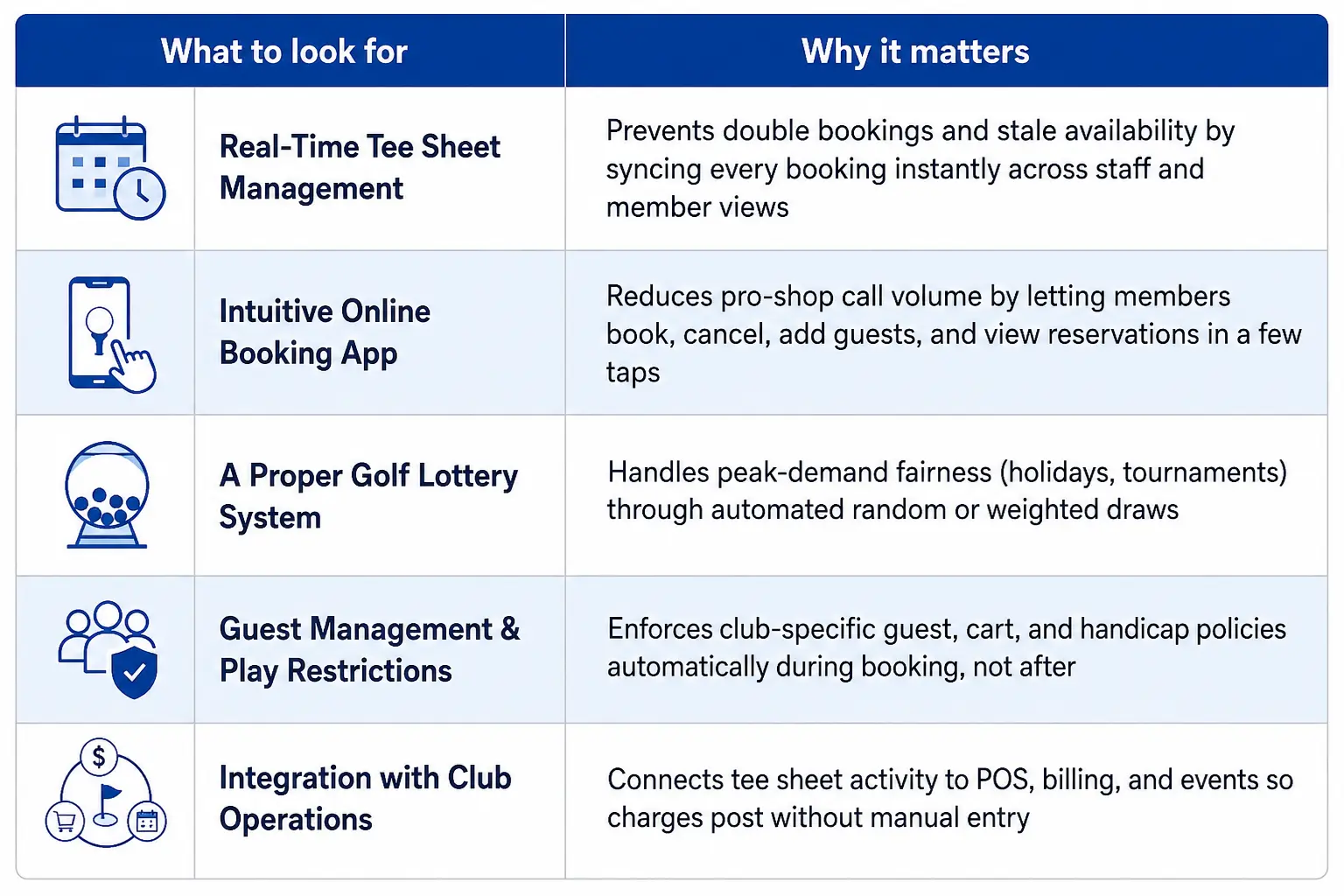
Real-Time Tee Sheet Management
A tee sheet is only as useful as its accuracy. The best golf scheduling software gives both staff and members a live, up-to-the-minute view of available slots without lag or constant need to refresh. When a member books through the app, that slot should disappear from every other view instantly. Anything less creates conflicts, frustration, and more work for your pro shop team.
Look for tee sheet management that handles variable slot intervals, allows booking window controls by membership tier, and gives staff the ability to block, hold, or modify times without navigating a multi-step process.
Intuitive Online Tee Time Booking App for Members
The bar for member-facing booking tools has risen significantly. A clunky portal that technically allows online reservations but takes eight steps to complete one won’t reduce pro shop call volume. The right online tee time booking software is intuitive enough to require no training, works cleanly on mobile, and gives members complete control: booking, cancelling, adding guests, and viewing upcoming reservations, all from the same screen.
Some platforms are built with operators in mind and treat member-facing tools as secondary. Flip that priority when you’re evaluating; the member experience should drive the design, not the other way around.
A Proper Golf Lottery System
For busy private clubs, especially around holiday weekends, peak season windows, and tournament periods, a golf lottery system becomes an essential feature for member fairness and operational sanity. Yet this is one of the most inconsistently implemented features across the market.
A well-built golf lottery system should allow members to submit tee time requests as individuals, pairs, or full foursomes, including linked group requests. It should give clubs the flexibility to run random or weighted lotteries based on membership type, frequency of play, or club-defined criteria. And it should handle all of this automatically, without staff manually sorting through requests.
Platforms that offer a lottery feature as a bolt-on or an afterthought tend to show the cracks quickly when demand spikes. If your club regularly sees competitive demand for popular time slots, the lottery functionality deserves as much scrutiny as any other part of the software.
Guest Management and Play Restrictions
Most private clubs have complex rules regarding guests, cart assignments, and handicaps. It is vital that these policies are enforced automatically during the booking process rather than caught later by your staff.
Good reservation software embeds your club’s specific policies directly into the booking workflow. This reduces administrative work and prevents awkward conversations at the time of play. Purpose-built private club platforms generally outperform general-purpose tools in this area.
Integration with the rest of the Club Operations
A tee sheet that lives in isolation is a half-solution. The moment a tee time is booked, your POS, member billing, event management, and communication systems should all know about it. Cart fees, range ball charges, lesson bookings, and F&B charges tied to a round should flow directly into a member’s statement without manual entry.
This is where the gap between standalone golf scheduling software and a fully integrated club management platform becomes most visible. Standalone tools can handle the booking itself, but they create data silos everywhere else. Clubs that have moved to integrated platforms consistently report fewer billing errors, faster statement cycles, and staff who spend less time reconciling systems and more time with members.
How Platforms Compare and Where They Fall Short
The tee time software landscape roughly divides into three categories: standalone golf-only tools, fragmented club management systems with tee sheet modules, and modern truly integrated platforms. Each comes with a different trade-off between tee sheet depth, member experience, and how well it connects to the rest of club operations. The table below lays out where each one tends to win and where it tends to fall short.
| Standalone Golf-only Tools | Fragmented Club Management Systems | Modern Truly Integrated Platforms | |
| Tee sheet strength | Strong, purpose-built for booking | Deep but dated workflows | Strong, cloud-native |
| Member-facing experience | Decent, but not built for club complexity | Often clunky; predates mobile-first design | Polished, mobile-first by design |
| Billing/POS/event integration | Weak, usually bolted on, often imperfect | Strong in accounting and back-office | Strong, single connected data source |
| Best fit for | Public courses with simple needs | Clubs needing deep back-office/accounting depth | Private clubs with complex membership, billing, and multi-department needs |
| Main trade-off | Outgrown quickly by private clubs with complex rules | Capable but cumbersome day-to-day | Integrates the entire departments of the club giving a single club view. |
The key question when comparing isn’t which platform has the longest feature list. It’s which platform actually connects the features and whether the member-facing experience holds up under real-world usage.
Teetimes Checklist Before You Commit
Before sitting down for any demo, get clear on your own club’s answers to these:
What’s your current biggest tee time headache?
Pro shop call volume, double bookings, lottery fairness disputes, guest policy enforcement, or billing errors the answer shapes which features matter most.
How complex are your booking rules?
Clubs with tiered membership, strict guest policies, and seasonal restrictions need software that can encode those rules into the booking flow. Not all platforms handle complexity gracefully.
What does your member demographic look like?
If a significant portion of your membership is in the 35-and-under bracket, a polished mobile app isn’t optional. If your membership skews older, ease of use and phone-based fallback options carry more weight.
Does this software talk to your billing and POS?
Ask specifically not just whether an integration exists, but how it works, how often it syncs, and who owns the reconciliation when data doesn’t match.
What does support look like after go-live?
Implementation quality varies widely across vendors. Ask for references from clubs of similar size and type and find out specifically what the onboarding and training process looks like.
Where Northstar’s Tee Time Software Stands
Northstar’s golf module is built for the operational reality of private clubs, not adapted from a public course booking tool. Members can book tee times directly through the ClubNow member app or the online member portal, with real-time availability, guest management, and club rules enforced automatically at every step.
Northstar’s golf lottery system handles both random and weighted draws, allowing members to submit requests individually or as linked groups with the fairness and transparency that busy clubs require.
What sets Northstar apart is that every booking connects directly to member billing, POS, event management, and the club’s communication tools all within a single, unified platform. When a tee time is booked, the entire club knows about it. Charges post automatically. Members receive confirmations without staff lifting a finger.
For clubs evaluating tee time software in 2026, the right question isn’t just “does it handle bookings?” It’s “does it make the entire club run better?” That’s the standard Northstar is built to meet.
Check out how one of the top clubs turned their operations from fragmented to future-proof.
Also explore how leading Golf Course Management can change the story at your club.
The Bottom Line
Choosing tee time software is choosing the operational rhythm of your golf programme. Get it right, and it reduces friction for members, lightens the load on staff, and creates a seamless experience from the moment a slot is booked to the moment a member walks off the 18th green. Get it wrong, and it creates exactly the kind of daily frustration that quietly drives members toward resignation.
Take your time with the evaluation. Involve your head pro, your membership team, and your billing staff. And hold every platform to the same standard: does this make the member experience genuinely better, or does it just move the problem somewhere else?
Want to see how Northstar handles tee time booking, lottery management, and member reservations for clubs like yours? Explore the Golf Module or Book a Demo to see it in action.