








Losing a member is expensive. Quietly, steadily, and in ways that don’t always show up on the same spreadsheet as the loss itself, a member who stops engaging, stops booking, stops attending, and eventually stops renewing costs far more than the dues they take with them. By the time a resignation letter lands on the membership director’s desk, the club has already lost the real opportunity to change that outcome. That moment was months earlier, buried in a pattern of declining usage that nobody had the tools to spot in time.
This is the problem that modern membership management software is built to solve. Not just to store member records or automate renewal reminders, but to surface the signals that predict churn before it becomes a resignation and give clubs the data to act on them.
This guide covers what the best club member management systems actually do, how they compare to what clubs are still using, and why the gap between managing membership and truly driving retention comes down to the platform behind it.
The State of Private Club Membership in 2026
The club membership market is growing. Member expectations are rising. And the gap between clubs that are keeping up and those quietly losing ground is widening faster than most leadership teams realize. The data below depicts a story that cannot be ignored.
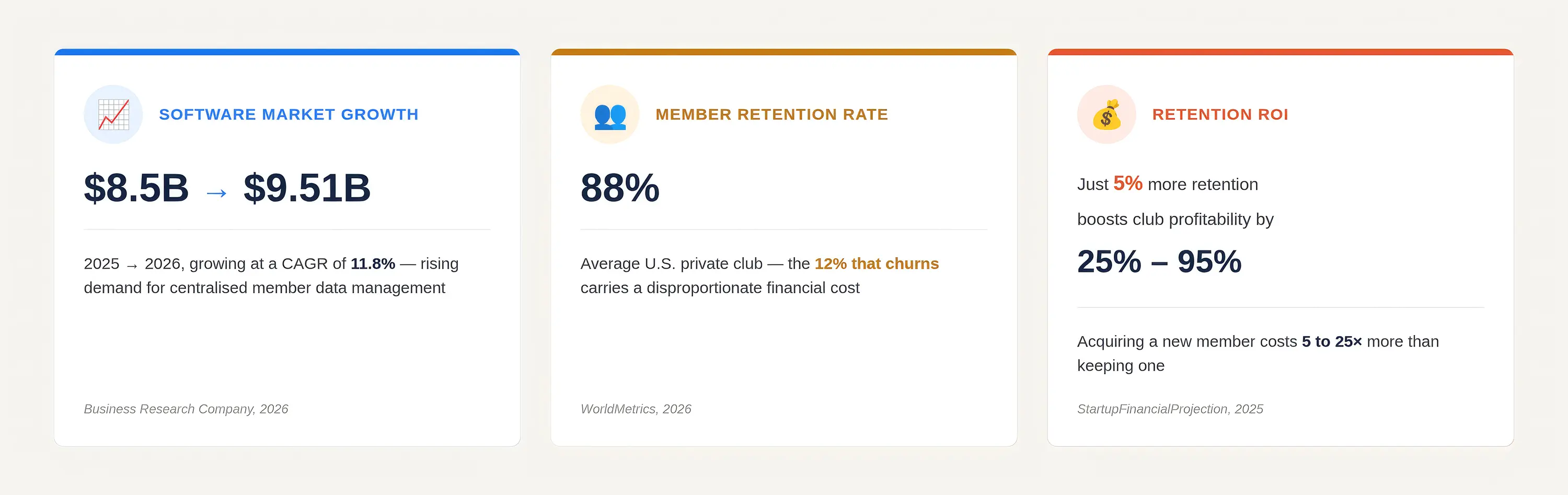
$8.5B → $9.51B
Membership management software market growth is from 2025 to 2026 at 11.8% CAGR, driven by rising demand for centralized member data management (Business Research Company, 2026)
88%
Average membership retention rate for U.S. private clubs: the 12% that churns carries a disproportionate cost (WorldMetrics, 2026)
5% → 25–95%
A 5% improvement in member retention can increase overall club profitability by 25% to 95%, because acquiring a new member costs 5 to 25 times more than retaining one (StartupFinancialProjection, 2025)
Run these numbers against your own membership base, and the business requirement for investing in comprehensive member retention software becomes very clear very quickly.
Why Member Retention Fails?
Most clubs treat churn as a satisfaction problem. Fix the service, fix the food, fix the experience, and the members will stay. That approach is incomplete. Because long before a member becomes dissatisfied enough to resign, they become disengaged. And disengagement is entirely preventable with clear enough visibility into what the members are actually doing, and more importantly, what they’ve quietly stopped doing.
Members using two or more benefits a year renew; non-engagers churn. The clubs that retain members at the highest rates aren’t necessarily offering better facilities or experience. They’re the ones that know which members are disengaging, and intervene before the disengagement becomes a decision.
The challenge is that member disengagement doesn’t announce itself. It shows up as a round that didn’t get booked, an event RSVP that didn’t come in, a dining visit that fell off the usual cadence. On their own, any one of those signals means nothing. Together, in the context of a member’s full engagement history, they’re a clear early warning.
Without membership-tracking software that captures and surfaces those patterns, clubs are essentially flying blind until renewal season. And by then, the cost of re-engagement, financially and relationally, is significantly higher than it would have been three months earlier.
“Most members are lost long before renewal day. The clubs that flag at-risk behaviour months ahead and intervene consistently recover members that a calendar reminder never would.” – MembershipQuest, 2026
That’s not a service philosophy. It’s a data problem, and it requires a data solution.
What a Modern Club Member Management System Actually Does
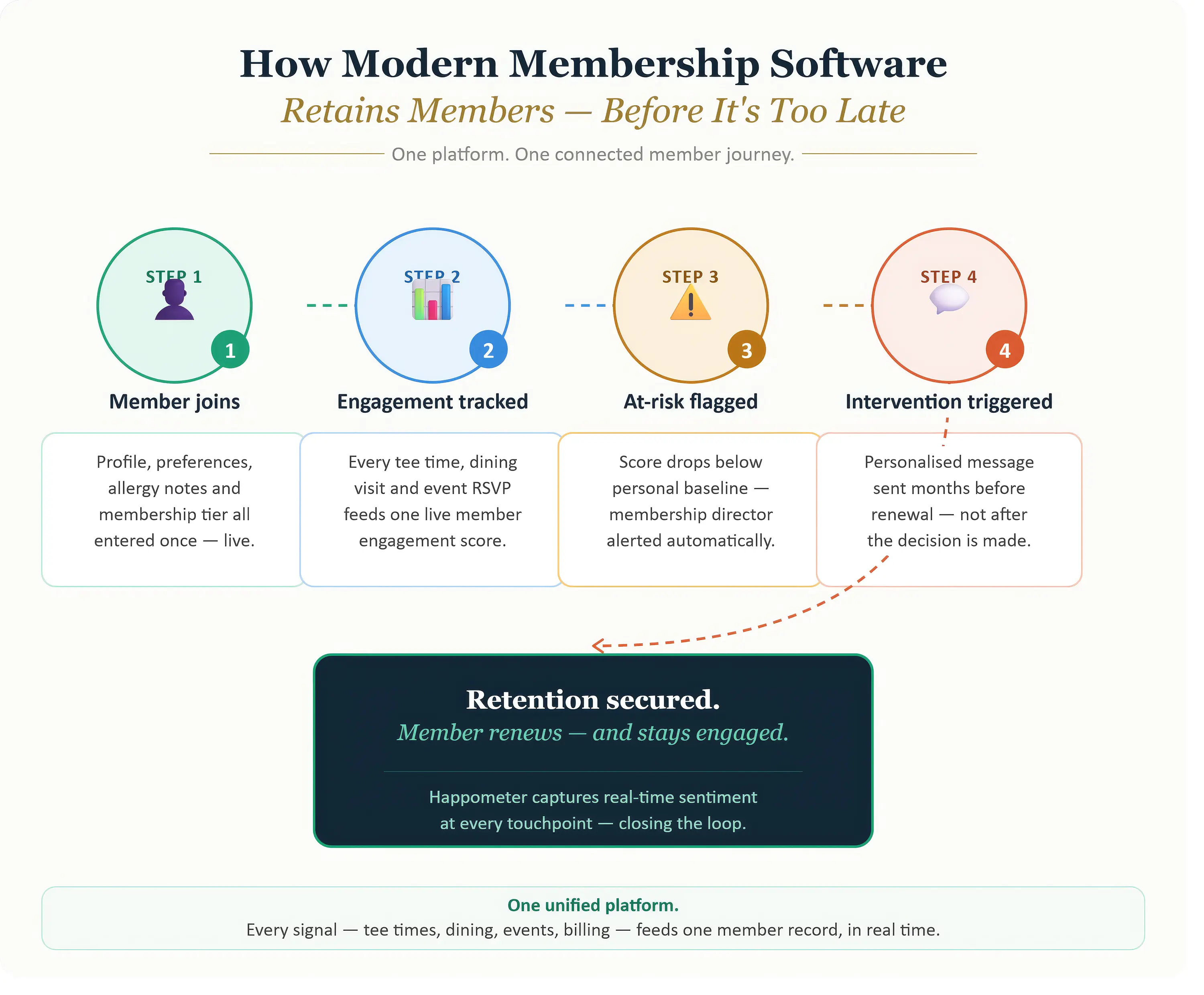
The term “membership management software” covers a wide spectrum of tools. At one end, you have database tools that store member information, process dues payments, and send automated renewal emails. At the other end, you have fully integrated member lifecycle management platforms that connect every touchpoint into a single, actionable view. The gap in results between these two approaches is profound.
Unified Member Profiles
Every interaction a member has with the club – every round played, event attended, dining reservation made, charge posted should feed back into a single, continuously updated member profile. Not a siloed record in the golf system. A separate entry in the F&B POS, and a third line in the accounting spreadsheet. One record, one source of truth, updated in real time.
That unified profile is what makes everything else possible: accurate engagement scoring, intelligent renewal forecasting, personalized communications, and at-risk member identification without requiring a staff member to manually cross-reference three different systems every week.
At-Risk Member Identification
A well-built member engagement platform should flag members whose activity is declining relative to their own historical baseline, not just against a club-wide average, but against what that specific member typically does.
A member who normally plays twice a week and hasn’t booked a tee time in three weeks is sending a signal. A member who used to attend four events a quarter and skipped the last two is sending a signal. The software should automatically catch those signals and surface them to the membership director, not wait for the membership director to go looking.
Research indicates that personalized experiences and timely interventions can lead to a 30% increase in member retention rates. But personalized intervention requires personalized data, and that data only exists if the platform is built to collect and interpret it.
Membership Tier and Lifecycle Management
Private clubs don’t have one type of member. They have full members and social members, junior members and corporate accounts, family memberships and reciprocal members from affiliated clubs. Each category has different pricing, access rights, communication preferences, and renewal rules.
Member lifecycle management means the software understands where each member is in their relationship with the club – new, established, at-risk, or lapsed. And surfaces them in the context that’s relevant to that stage. New member onboarding, first-year engagement tracking, anniversary milestones, and renewal sequencing. All these should be handled automatically, with the membership team alerted only when a personal touch is needed.
Automated Communications That Feel Personal
Bulk email blasts to your entire membership base is not a retention strategy. Nor are manually typed letters that go out to everyone in March because renewal season has arrived. Neither of those approaches reflects any knowledge of who the member is, what they care about, or where they are in their engagement journey.
The best clubs are now reaching members through the right channel, with the right message, at the right point in their membership lifecycle. Modern membership management software makes this possible by triggering personalized communications: a welcome sequence for new joiners, an activity prompt for members who haven’t visited in a while, a pre-renewal summary for members approaching their anniversary, and a win-back sequence for those who have recently lapsed.
Real-Time Reporting and Retention Analytics
Membership directors shouldn’t have to wait until the end of a quarter to understand ongoing retention trends. A proper member management system highlights this in real time. Current retention rate, renewal pace against the same period last year, at-risk member count by category, average engagement score across the active membership, and which programs are driving the strongest attendance among first-year members.
When these numbers are visible and current, the decisions are made proactively rather than in retrospect. Decisions such as where to invest in programming, which member segments need more attention, and whether a specific initiative is moving the needle are made proactively.
How Platforms Compare: What to Watch For
Several platforms in the club technology market have been built specifically around membership administration: dues processing, renewal workflows, basic CRM. While these tools are extremely competent at their job, they operate in isolation from the rest of the club. Tee time data, F&B engagement, event attendance, and billing activity sit in separate systems that show stats but do not tell a story, which means the engagement picture they show is fragmented.
When a membership director’s primary tool doesn’t know whether a member played last week or attended an event last month, the “at-risk member” reports are based on billing patterns alone. This is just a spreadsheet that lacks the capability of live engagement data.
Fragmented Systems vs. Modern Integrated Platforms
How they compare across the areas that matter most for member retention
| CRITERIA | Fragmented Systems | Modern Integrated Platforms |
| Feature Depth
Dues, billing, accounting |
✕ Years of deep feature development in membership modules, particularly dues structures, billing rules, and accounting integration. | ✓ Membership sits inside a fully integrated club ecosystem, sharing one data model with tee times, events, F&B, and communications. |
| Engagement Analytics
Tracking member behavior |
✕ Hasn’t kept pace with the shift toward engagement analytics. | ✓ Engagement scoring is based on actual behavior across the whole club, not just what the membership module can see. |
| Mobile-First Access
Member app and self-service |
✕ Hasn’t kept pace with mobile-first member access. | ✓ Reflects the expanding adoption of mobile-first membership platforms across the industry. |
| Retention & Relationship Management
Proactive tools, not just records |
✕ Functional for record-keeping, but not built to support the relationship management that drives retention; lacks proactive retention tools. | ✓ A single shared data model gives a structural advantage in retention management, with every interaction feeding back automatically. |
| Real-Time Member Sentiment
Tracking how members feel |
✕ Interface assumptions predate the idea that a club should be actively tracking member sentiment and usage patterns in real time. | ✓ Every interaction across every department feeds back into the member profile automatically, in real time. |
| Market Direction
Where demand is heading |
✕ Users frequently describe membership management as one of the weaker areas of these platforms. | ✓ Growth is driven by demand for personalized experiences, AI-driven engagement tools, and SaaS-based solutions, already in use at the clubs retaining members most effectively. |
The Member Lifecycle: Where Technology Needs to Show Up
Good retention is built based on the entire member lifecycle, and the software has to support every stage of it.
- Acquisition and onboarding: The first 90 days of membership are when retention is won or lost. A member who doesn’t connect meaningfully with the club in their first three months is far more likely to churn in year one. Automated onboarding sequences, tailored introductions, booking prompts, and event invitations. This helps bridge that gap without requiring manual follow-up from the membership team for every new joiner.
- Engagement tracking: Throughout the membership, the platform should be continuously scoring each member’s engagement relative to their own history. Not a static report run once a month, but a living view that flags changes in behavior as they happen.
- Intervention at the right moment: When a member’s engagement score drops below a defined threshold, the membership team should know automatically, before that member has made any decision about renewing. The window for effective intervention is several months before renewal, not in the final weeks before the invoice goes out.
- Renewal and re-engagement: The renewal process itself should be streamlined, digital, easy to complete, with clear communication of the value the member has received. For lapsed members, a segmented re-engagement campaign based on their specific history with the club will outperform any generic win-back email.
- Ongoing relationship management: Retention isn’t a one-time campaign. It’s built through consistent, personalized engagement across every touchpoint. And the software should be making that consistency achievable without requiring a disproportionate amount of staff time to maintain.
Where Northstar’s Membership Management Platform Stands
Northstar’s Membership Management module is built inside the same unified platform as tee time management, F&B, events, and member communications. That matters because it means the engagement data feeding into member profiles is comprehensive. Every round played, every dining visit, every event RSVP, every charge posted, all connected to the same member record in real time.
The platform’s at-risk member identification surfaces declining engagement patterns before they become resignation decisions. This gives the membership team a prioritized list of members who need attention and the context to make every interaction count. Renewal automation, lifecycle communications, and tier management all run from the same system. So the membership director is working from one dashboard, not coordinating across five platforms.
Northstar’s Happometer adds the dimension that most membership management platforms miss entirely: direct member sentiment. Rather than inferring how a member feels from their activity patterns alone, Happometer captures real-time feedback at the moments that matter after a dining experience, a round, or an event. This gives clubs a continuous, honest signal of member satisfaction that sits alongside engagement data in the same platform.
“Northstar helped us move from six different systems that did not speak to each other, to one consolidated data platform. This helped us become more efficient and much more effective in serving our members.”
— Waialae Country Club — Honolulu, Hawaii
Hear from Cindy Rangel how Northstar’s integrated software has helped to keep track of their members and grow the club’s membership.
Explore how to close the connection gap in clubs to boost member retention and how to maximize your club brand and communications with membership marketing
The Bottom Line
Membership retention isn’t a membership team problem; it’s a data problem. The clubs solving it most effectively are the ones that have invested in platforms that give them a complete, real-time picture of every member’s engagement. And the tools to act on it before churn becomes a resignation.
“Increasing retention by just 5% can boost profits by 25%–95%. For clubs, this means that long-term growth is not only about attracting new members. It’s about keeping the ones you already have engaged, satisfied, and loyal.” — ClubAutomation, 2025
The right membership management software doesn’t just make that case. It makes it happen – automatically, consistently, and at a scale that no manual process or siloed system can match.
Ready to see Northstar’s Membership Management Platform in action? Book a Demo