







The global marina management services market was valued at $6.8 billion in 2025 and is projected to reach $12.4 billion by 2033 at a 7.8% CAGR. This rapid acceleration reflects a major industry shift: yacht clubs and marinas are replacing manual processes with unified digital platforms to improve operational visibility, automate complex billing, and streamline dockmaster workflows.
Behind this growth is the high-stakes reality of modern waterfront operations, balancing slip assignments, utility metering, vessel compliance, and member expectations across an interconnected club environment. Choosing the right software transforms these daily administrative burdens into a clear operational advantage. Use this guide to evaluate your software needs and determine if your current setup is building a foundation for growth or restricting productivity.
The decision can be reduced to three questions:
As you evaluate technology, don’t get lost in feature checklists or ‘nice-to-have’ modules. Every platform you review should be measured against these three foundational questions.
- Can the system manage the marina?
Slip assignments, vessel records, reservations, billing, documentation, events, and dock operations. - Can it connect the marina to the club?
Membership, accounting, F&B, events, communications, and member-facing services. - Can it make the operation easier to manage?
Real-time visibility, fewer manual processes, better reporting, and a smoother member experience.
The best marina management software should do more than assign slips. It should connect slip management, vessel documentation, reservations, billing, member records, dock operations, and reporting in one operational environment. For yacht clubs, that connection is what determines whether the software simply manages the marina or helps the entire club operate more efficiently
Why Generic Software Fails Marina and Yacht Club Operations
General-purpose club management tools and spreadsheets often struggle under the weight of specialized waterfront operations. Because marinas operate under unique rules—from transient slip assignments and liveaboard utility billing to vessel compliance and sublease revenue splits—generic solutions create friction, manual workarounds, and operational siloes.
Adopting a purpose-built, outcome-led platform transforms these complex workflows into distinct operational advantages for your team and members:
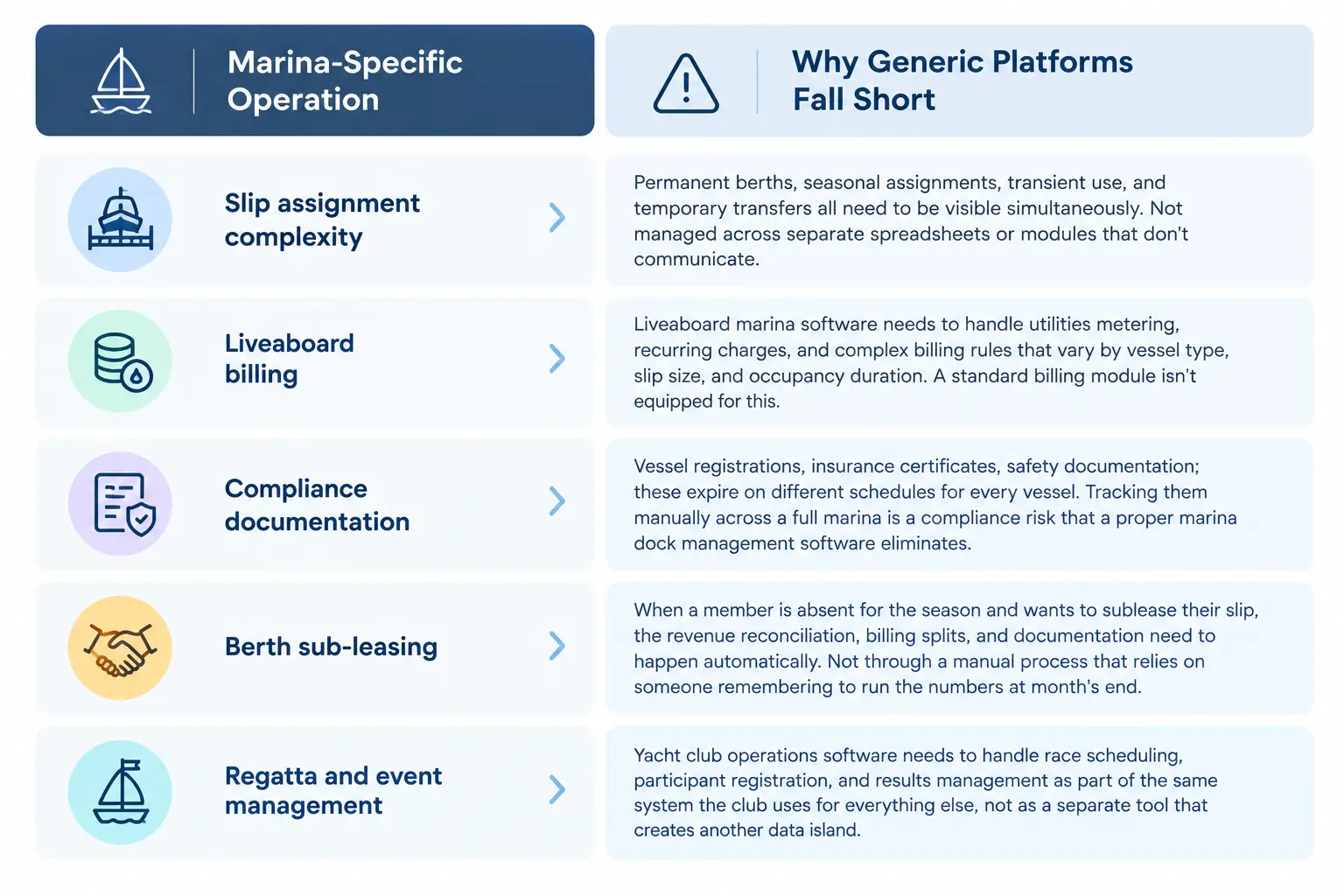
Addressing these specialized requirements requires moving beyond fragmented systems. Connecting these operational gaps into a single cohesive system creates clear visibility across the waterfront, eliminates tedious administrative overhead, and provides a seamless experience for both staff and members.
Key Business Outcomes of an Integrated Marina Platform
- Complete Slip & Dock Visibility: Gain total real-time control over permanent berths, seasonal assignments, transient reservations, and temporary transfers in a single dynamic view, eliminating scheduling conflicts and maximizing dock utilization.
- Automated & Accurate Billing: Seamlessly capture utility metering, recurring liveaboard fees, and vessel-specific rates directly into member accounts, removing manual entry errors and speeding up billing cycles.
- Proactive Compliance Management: Effortlessly track vessel registrations, insurance certificates, and safety documentation with automated renewal alerts, mitigating liability risks and ensuring total harbor safety.
- Hassle-Free Sub-Leasing: Automate revenue splits, accounting postings, and documentation when members sublease their slips, maximizing berth usage while delivering a seamless financial experience.
- Unified Regatta & Event Operations: Integrate race scheduling, participant registration, and results tracking directly with member profiles, bringing waterfront events into the broader club lifecycle without separate software tools.
These gaps are why purpose-built marina management capabilities matter. The key question is whether those capabilities operate independently or connect directly with the club’s broader member, financial, and operational systems.
Where Northstar’s Marina Management Platform Stands
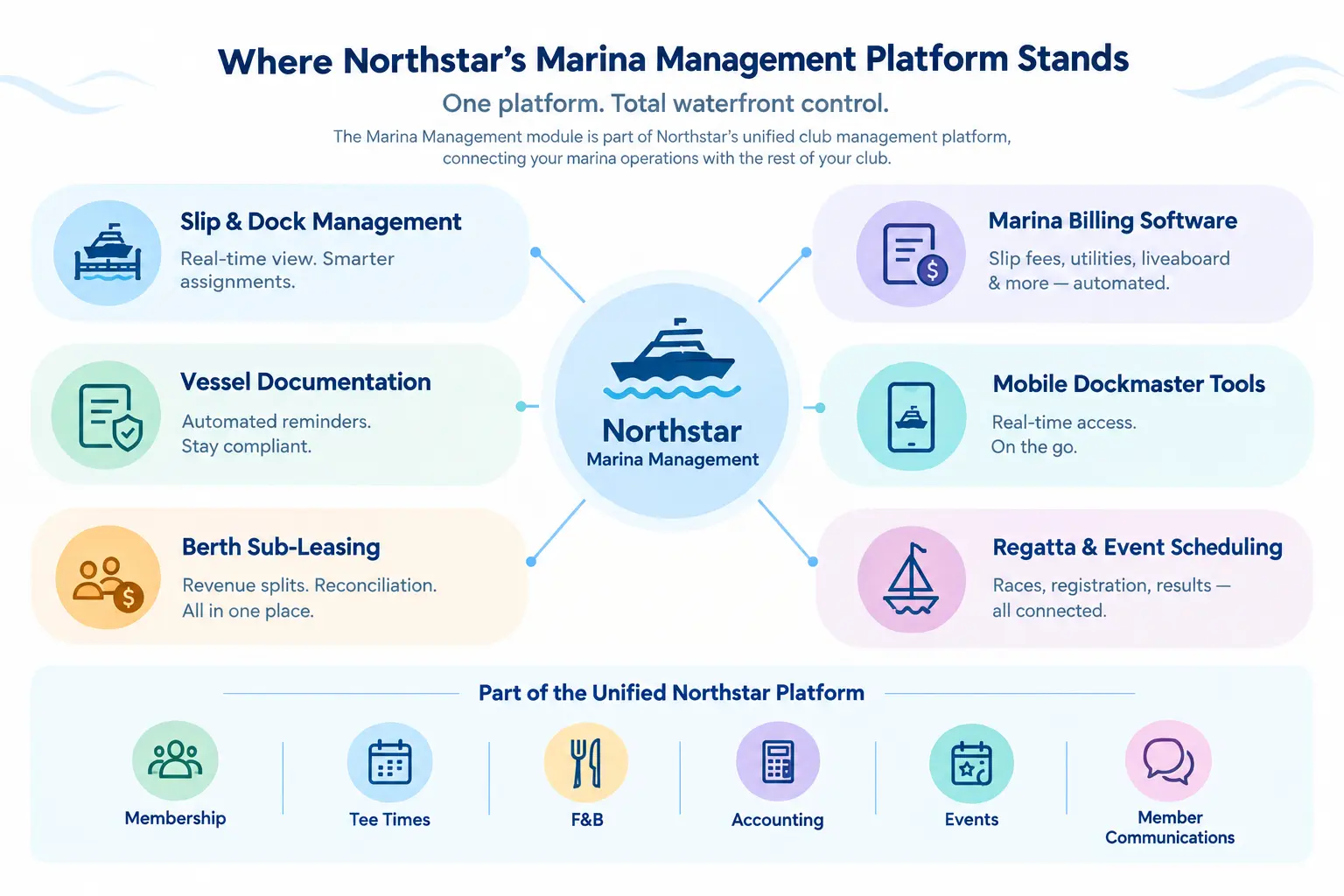
Measured alongside the framework, here is how Northstar’s Marina Management module holds up in practice. It sits inside the unified club management platform alongside membership, tee times, F&B, accounting, events, and member communications.
Slip and Dock Management
Northstar provides a real-time, bird’s-eye view of the marina layout, allowing teams to see occupancy and drill into individual slip details, including vessel information, member profiles, documents, and charges. Permanent, seasonal, and transient assignments can be managed from the same environment. This complete operational transparency eliminates scheduling double-bookings and helps staff maximize dock space utilization to capture additional transient revenue.
Vessel Documentation
Vessel documentation is connected directly to member and vessel profiles. Automated reminders can be configured for expiring registrations, insurance certificates, and compliance documents, helping staff stay ahead of expiration dates instead of relying on manual tracking. By automating compliance tracking, managers significantly reduce liability risks and eliminate hours of manual admin work every month.
Berth Sub-Leasing
When a member subleases a berth, Northstar handles the associated revenue splits, account postings, and reconciliation within the platform. That reduces the manual calculations that can otherwise occur when a member’s slip is temporarily occupied by another party. This automated financial flow ensures accurate revenue sharing without administrative overhead, providing a seamless financial experience for members.
Marina Billing Software
Northstar supports waterfront billing requirements including slip fees based on vessel size, utilities charges by berth, liveaboard recurring charges, and transient daily rates. These charges flow into member statements and the accounting system rather than requiring separate manual entry. Streamlining dockside charges directly into primary billing accelerates monthly closing cycles and eliminates costly manual entry errors.
Mobile Dockmaster Tools
Dockmasters can access slip assignments, reservations, member vessel information, and check-in processes from a handheld device while working across the property. Empowering staff with mobile capabilities increases dockside productivity and elevates member service by handling requests instantly anywhere on the waterfront.
Regatta and Event Scheduling
Regatta and event scheduling can operate within the same environment as other club activities, connecting participant registration, member communications, and event billing to member profiles. Unifying waterfront events with broader club management drives member participation and boosts overall event revenue through streamlined registration.
For clubs already using Northstar across other departments, the Marina module extends the same platform to waterfront operations. The objective is a connected operational environment from dock to dining room and slip assignment to member statement.
Explore: Northstar’s integrated marina and yacht club management software
Read: Integrating Marina Management Software for Smooth Sailing at Your Club
Waterfront Club Management: The Integration Imperative
Integration matters because the operational cost of disconnected systems extends beyond duplicate data entry. It affects billing accuracy, reporting, staff productivity, and the member experience. For club leadership, the measurable question is how many manual handoffs the platform eliminates and how much operational visibility it creates in return.
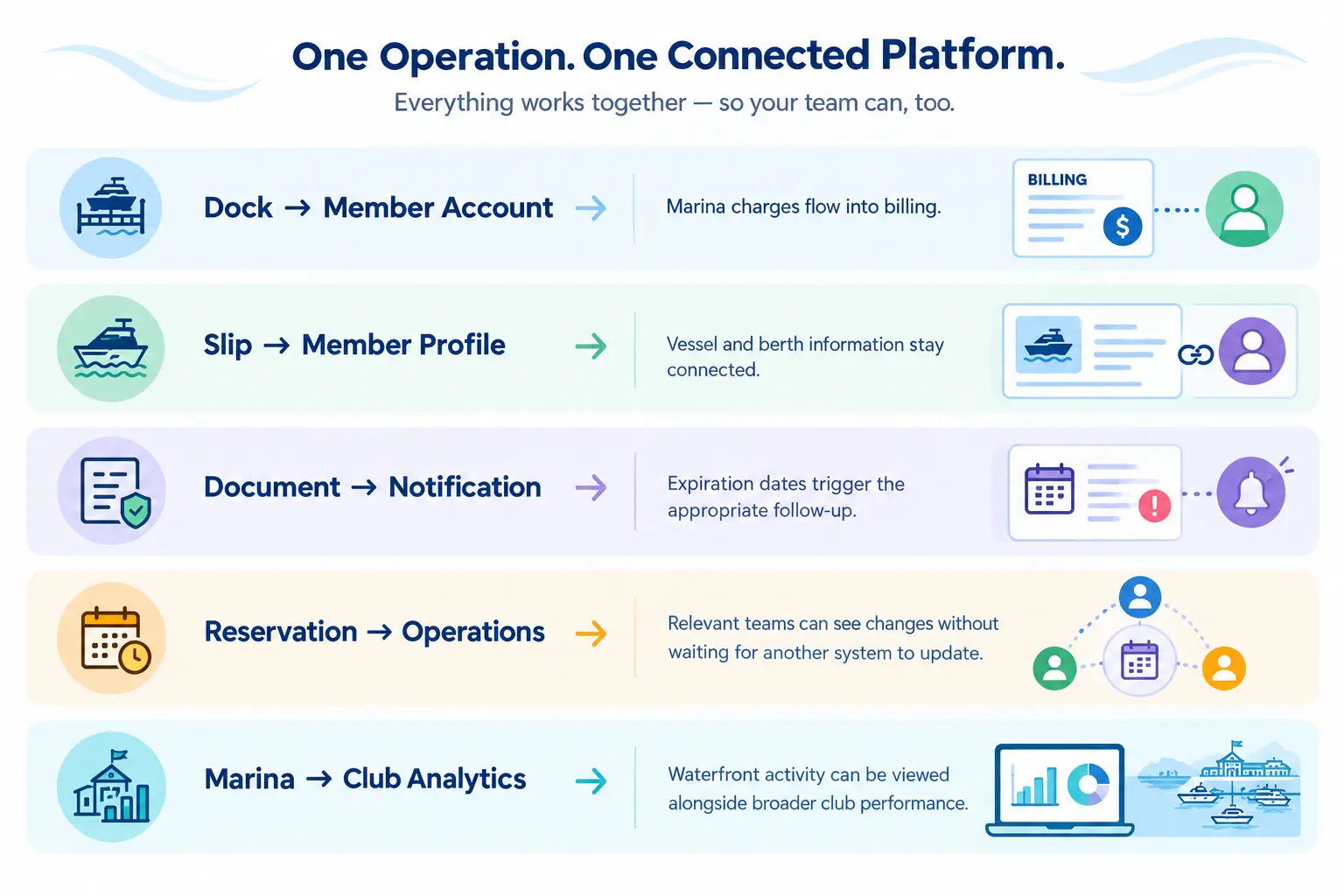
For a GM or Controller, that’s the real business case for integration: less reconciliation, better visibility, and more confidence in the information used to run the club.
See It in Action
Before reading any further, watch how Northstar’s Marina Management module handles the full operational picture. Slip assignments, reservations, billing, and dockmaster tools, all in a single, connected system:
Streamline Your Marina Operations with Northstar’s Integrated Marina & Yacht Club Management Software – Streamline your marina operations – Northstar’s integrated Marina & Yacht Club Management Software
How Platforms Compare: What to Watch in the Market
For yacht clubs and private clubs, marina management is not an isolated function. It is part of a broader operation that includes membership, accounting, F&B, events, and communications. The software approach a club chooses can determine how well these functions work together—or how much manual effort is required to connect them.
The differences become clear when comparing standalone marina tools, fragmented club systems with marina modules, and modern integrated club management platforms. The distinction isn’t simply which platform has the most marina features. It is how the marina connects to everything else happening at the club.
The marina software landscape can be broadly grouped into three approaches, each with different implications for club operations and the member experience:
Strengths |
Key Limitations |
What It Means for the Club |
|
Standalone Marina-Only Tools |
-Deep functionality for slip management, fuel tracking, and transient reservations. -Suitable for commercial marinas operating independently. |
-Marina data remains separate from club systems. -Member billing often requires manual reconciliation. -Marina engagement data does not feed into the broader membership picture. -Analytics are limited to marina-specific data. |
A capable marina solution, but a disconnected club experience. The marina can operate effectively while remaining isolated from membership, F&B, events, and other club operations. |
Fragmented Club Systems with Marina Modules |
-Established club-management platforms with dedicated marina functionality. -Generally strong accounting and billing integration. -Mature systems can handle many billing requirements reliably. |
-Marina modules may rely on older interfaces and workflows. -Limited real-time visibility. -Document management can require manual steps. -Compliance tracking and reporting may require workarounds. |
Better integration than standalone tools, but operational friction can remain. Clubs may still lack the mobile-first experience and real-time visibility modern marina operations increasingly require. |
Modern Integrated Club Management Platforms |
-Marina, membership, accounting, F&B, and communications share one database. -Real-time visibility across operations. -Automated notifications for document expirations. -Slip assignments and transactions are visible across the organization. -Connected billing and analytics. |
-The advantage depends on the marina being a native part of the integrated platform, rather than simply an add-on module. | One connected operational ecosystem. Dockmasters, membership teams, F&B managers, and accounting teams work from the same source of information, reducing silos and improving the overall member experience. |
The evolution is clear: from managing marina operations separately to connecting the marina with the entire club. For club leaders, the value of integration goes beyond reducing manual work. It creates a more complete view of operations, connects information across departments, and helps deliver a more consistent member experience. As marina operations become increasingly digital, the ability to manage them within a single connected club ecosystem is an important consideration when evaluating club management technology.
Modern Integrated Club Management Platforms
Platforms built as fully integrated club ecosystems where the marina module, membership, accounting, F&B, and communications all share a single database have a structural advantage in marina operations. Every transaction at the dock flows directly into member billing. Each document expiry triggers an automated notification. Every slip assignment is visible in real time across the whole operation. The dockmaster works from the same system as the membership director, the F&B manager, and the accounts team.
Cloud-based systems are dominating the marina software market while hybrid solutions are emerging as the fastest-growing segment, with integration for real-time asset tracking, mobile applications for customer engagement, and AI-driven analytics for predictive maintenance all becoming prevalent. The platforms leading this evolution aren’t adapting marina features onto existing club software. They’re building marina management as a native module within a unified operational platform.
Modern integrated platforms bring marina management, membership management, accounting, F&B, communications, and other club functions into a shared operational environment. The benefit is that information created at the dock doesn’t have to remain at the dock.
For example:
- A slip assignment can be reflected across the operation in real time.
- Marina transactions can flow into member billing.
- Vessel documentation can remain connected to the appropriate member and vessel record.
- Document expirations can trigger notifications.
- Dock staff can access operational information from mobile devices.
- Marina activity can contribute to broader club reporting.
The broader market is also moving toward cloud-based platforms, mobile engagement, real-time asset tracking, and analytics. DataIntelo’s current market research identifies cloud-based deployment as the leading deployment mode for marina management services.
Questions to Ask:
Choosing marina management software shouldn’t begin with a vendor demo. It should begin with a clear understanding of what the club needs the system to accomplish.
How does the slip layout update in real time?
Ask for a live demonstration with an actual booking. This is one of those features that looks good in a sales presentation and is poorly implemented in a surprising number of platforms.
How does document expiry work?
Ask how many days in advance automatic reminders go out, whether they’re customizable by document type, and what happens when a document expires without renewal.
What does the mobile dockmaster tool actually cover?
Full slip assignment visibility and reservation management from a mobile device or just a view-only summary that still requires a trip to the office to make changes?
How does the marina connect to accounting?
Ask whether transactions flow directly into the accounting environment or require exports, imports, or reconciliation.
Can the marina share data with membership and other club departments?
A true integration should allow the same member and vessel information to support multiple operational workflows.
What reporting can management see?
Ask to see reports for occupancy, revenue, billing, reservations, documentation, and other marina KPIs, and whether those insights can be combined with broader club data.
What happens when the club grows?
If the club adds slips, expands facilities, introduces new services, or operates multiple properties, understand how easily the platform can scale with it.
What does the go-live process look like?
Marina operations can’t stop for implementation. Understand the migration plan for existing slip assignments, vessel records, and historical billing data before you sign anything.
What does support look like after go-live?
Ask for references from clubs with similar operational complexity and understand what implementation, training, support, and ongoing account management look like.
The objective is to evaluate not just what the software can do, but how it performs when your staff and members are actually using it.
What Clubs Are Saying
The strongest software evaluation isn’t based solely on a vendor’s feature list. It also considers what the implementation and ongoing partnership look like for clubs operating in the real world.
At Brays Island Plantation, the organization operates across multiple areas including golf, equestrian, quail hunting, kennels, rooms, and a marina. Executive Director Lauren Wunder-Wester describes the Northstar onboarding experience and the platform’s ability to configure around the club’s needs.
“Onboarding with Northstar has been a great experience. Our club is unique with golf, equestrian, quail hunting, kennels, rooms, a marina, and more, and Northstar was able to configure the system to meet all our needs. The team has always been open, helpful, and willing to enhance the platform to fit us. It’s been a tremendous partnership.” — Lauren Wunder-Wester, Executive Director, Brays Island Plantation
At Royal Freshwater Bay Yacht Club, CEO Andy Fethers highlights the impact of consolidating previously disparate systems and putting members and their boats at the center of the operating system.
“Northstar has consolidated over 15 previous disparate systems, placing the members and their boats central to the operating system. The common modules have developed staff in training, support, and cross-departmental integration. Our members are benefiting as efficiency is achieved and services increased.” — Andy Fethers, Chief Executive Officer, Royal Freshwater Bay Yacht Club
These experiences illustrate an important point: the value of marina software is not confined to marina administration. For a club operating across multiple amenities and departments, the technology becomes more valuable when it can support the organization as a connected whole.
The Bottom Line
Marina and yacht club operations are complex because the marina itself is complex, and because it rarely operates independently from the rest of the club.
The clubs evaluating technology in 2026 should look beyond the marina module itself and examine the platform behind it. The strongest solution is the one that can manage marina-specific complexity while keeping the marina connected to the rest of the club.
If your current system still requires staff to manually reconcile marina data with accounting, maintain duplicate member records, or move information between disconnected platforms, the operational cost may be greater than the software license itself.