



When an enterprise software system fails at a standard commercial business, the cost is typically measured in lost administrative hours or delayed support tickets. At a premier, member-owned private club, system failure carries a higher tax of immediate erosion of member trust. When core technology falters, whether through a lagging point-of-sale terminal at a crowded beach club or an outage during peak dinner service, the friction is felt instantly by the club’s most valued stakeholders. For executive club leadership, maintaining flawless digital infrastructure is a direct extension of white-glove hospitality.
For more than a century, Jonathan Club has stood as an enduring pillar of California’s social, cultural, and civic life. Operating across two distinct, world-class properties—a historic 12-story Beaux-Arts Town Club in the heart of downtown Los Angeles and a sprawling beachfront oasis in Santa Monica—the club provides an unparalleled retreat for its membership.
Managing an enterprise footprint of this caliber requires an operational backbone that matches the quality of its hospitality. Between high-volume oceanfront dining, private athletic centers, luxury guest lodgings, wellness spas, and complex committee governance, the sheer scale of daily operations is immense. The club caters to roughly 4,000 primary members; a figure that swells to over 16,000 active account holders when accounting for spouses, partners, and children.
Delivering flawless operational consistency for 16,000 discerning stakeholders leaves zero room for system latency, corrupted financial logs, or fragmented member records. Yet, thirteen years ago, maintaining this dual-site enterprise required navigating a complex web of disconnected software systems that were increasingly struggling to keep pace with the club’s operational standards.
The Catalyst for Change: Why a 15-System Stack Failed the Operations Test
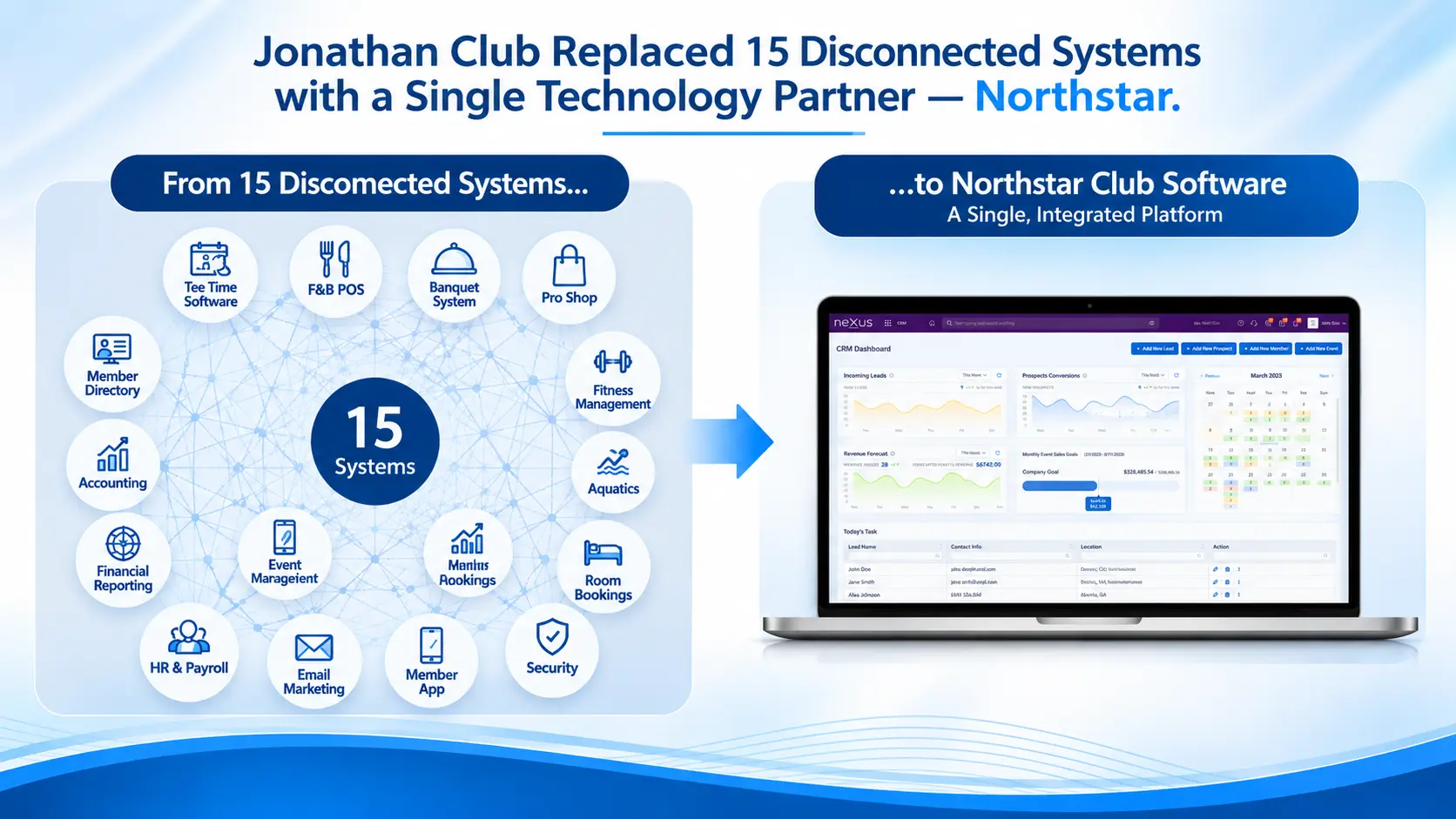
Thirteen years ago, Jonathan Club’s technology ecosystem had grown the way many long-established clubs’ stacks do: department by department, with little central coordination. Over time, the club found itself managing approximately 15 separate software platforms across its two properties.
Core accounting, lodging, point-of-sale, catering, and departmental workflows each ran on standalone tools. Where core systems fell short, individual teams built custom desktop databases and manual spreadsheets to plug the operational gaps. The club lacked a mobile app, and member web services relied on basic third-party hosting.
The core vulnerability was not any single application, but the seams between them. With only two platforms even attempting to communicate through an interface, broken connections routinely triggered multi-day standoffs between separate software vendors while staff scrambled to keep operations moving.
“We had I think 15 different systems, all of which only two tried to communicate through an interface. The challenge was anytime one of these systems broke or was supposed to be communicating with another system, it would take three or four days to get the two companies to work together to try to resolve the issue. So I was looking at a one-database solution more than anything else—one house to basically cover the majority of what we do at the club.”
— Charles Boyer, Chief Technology Officer, Jonathan Club
Financial administration suffered equal friction. Closing month-end member statements required waiting nearly a full day for databases to calculate balances, followed by staff manually generating and uploading large data files to the website by hand. For Charles, the operational directive was clear: eliminate the fragmented multi-system stack and consolidate onto a single database architecture.
Evaluating the Market & Choosing a Partner
When Jonathan Club initiated its search for an enterprise solution, leadership evaluated several established players across the club management software market. While many legacy options provided functional tools for specific operational areas, none offered a truly unified, end-to-end platform capable of supporting the club’s dual-site scale.
More importantly, traditional vendors showed little appetite for customization, often restricting clients to rigid off-the-shelf software models.
For Charles and his team, selecting Northstar represented a deliberate strategic shift: choosing a collaborative technology partner over a static software vendor. Though Northstar was a younger company at the time with prominent institutions like the Harvard Club of New York among its key enterprise references, its willingness to listen and co-develop tailored functionality set it apart.
“We looked at several different other companies and none of them really had a complete solution. Under that one pane of glass, Northstar was the only provider that said, ‘Yeah, we’ll work with you to build out what you need and we have most of it already, and we can enhance what we don’t have and get it into the system. I think it’s important to have that technology partner relationship versus just having a technology vendor.”
— Charles Boyer, Chief Technology Officer, Jonathan Club
Another decisive factor was support infrastructure. To validate Northstar’s 24*7/365 service claim during evaluations, the team conducted an unannounced test: calling Northstar’s global support center at 3:00 AM local time before even signing a contract. A support engineer answered immediately, ready to assist. That level of responsiveness confirmed Northstar had the service backbone required to support Jonathan Club’s round-the-clock operations.
Boosting Speed of Financial Workflows
Deploying a unified database delivered immediate, measurable performance gains across both properties. Most notably at the Santa Monica Beach Club’s Surfside Grill, the club’s highest-volume food and beverage outlet.
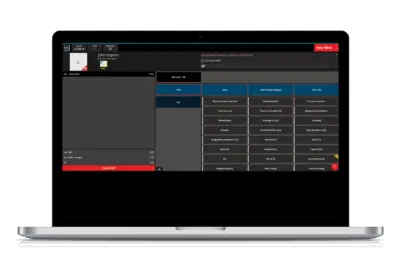
Under the legacy architecture, remote POS terminals experienced severe latency, forcing staff to wait two to three seconds per click while orders processed across intermediate server layers. Replacing that multi-server workaround with Northstar’s web-native browser, Jonathan Club eliminated secondary hardware entirely and slashed click-response times to under 0.25 seconds.
“Our furthest location from our data center is the Santa Monica Beach Club, and it’s our highest, busiest outlet called the Surfside Grill. We went from having sometimes a three-second delay on a click to under a quarter of a second by the time we were all said and done with Northstar. And that was with no improvement whatsoever on the networking side.”
— Charles Boyer, Chief Technology Officer, Jonathan Club
In the finance department, processing velocity improved dramatically. Monthly statement compilation which was a laborious day-and-a-half endeavor involving manual CSV builds was streamlined into an automated background run, completing full generation and print dispatch in under four days.
Furthermore, system stability eliminated mid-day database rollbacks that historically froze accounting staff for hours, while credit card tokenization removed Jonathan Club from PCI compliance scope entirely.
| Operational Indicator | Legacy Multi-System Setup | Unified Northstar Platform |
| POS Latency (Surfside Grill) | 2.0 to 3.0+ seconds per click | Under 0.25 seconds per click |
| POS Infrastructure Overhead | Required dedicated terminal | Native in-browser execution |
| Monthly Statement Run | 1.5 days manual compile & web upload | Automated run & print in <4 days |
| Mid-Day Accounting Rollbacks | Frequent (3-hour operational halts) | Zero database rollbacks in years |
| PCI Scope Compliance | Annual complex audit burden | Zero scope via tokenization |
Building Smart Automation & Custom Enterprise Modules
Jonathan Club’s relationship with Northstar extends beyond standard software implementation into true product co-development. Over the course of the partnership, the club served as the driving force behind three core platform modules that now serve Northstar’s broader global user base:
- Spa Management: Complex appointment scheduling, provider management, and service billing built directly into the central member profile.
- Concierge Services: Dedicated tools to track member preferences, reservations, and front-desk requests.
- Clubs & Committees: Governance tracking, committee roster management, and communication tools.
Beyond core software modules, Jonathan Club integrated Northstar with its physical room infrastructure; connecting lodging property management system (PMS) data with dormakaba smart door locks and Honeywell INNCOM energy management systems.
When a guest checks in at the front desk, Northstar automatically signals the room system to turn on entry lighting for 10 minutes and activate the HVAC to cool or warm the room to the target temperature. If the member does not enter the room within 15 minutes, the energy management system automatically powers down the lights and climate control, delivering measurable utility cost savings while ensuring a premium guest arrival experience.
The Single-Day Cutover and the Horizon Ahead
Transitioning core software across multiple physical properties is often viewed as a major operational risk. Jonathan Club mitigated this risk through a structured single-day cutover across both the Downtown Town Club and the Santa Monica Beach Club.
Staff completed three days of hands-on training on a sandbox demo system before go-live. The primary operational concern was whether the point-of-sale system could handle complex restaurant workflows which included coordinating 25 kitchen printers and intricate modifier routing between hot and cold line stations across high-volume dining outlets.
The cutover succeeded with minimal member impact, supported directly on-site by Northstar’s implementation team working around the clock alongside internal staff to resolve final configuration details before doors opened.
With a stable, unified database established, Charles and his team continue to expand the platform’s scope across several forward-looking initiatives:
- In-Room Media & Interactive Hospitality: Expanding integrations with in-room entertainment systems (such as Inspire) to allow guests to book spa treatments, view dining menus, and set automated wake-up calls directly from their room displays.
- Targeted Push Communications: Transitioning routine member engagement away from cluttered email channels in favor of personalized mobile app push notifications.
- AI-Assisted Member Services: Exploring natural-language AI integrations to allow members to query event schedules, facility availability, and dining reservations on demand.
“I want somebody to be able to talk to their phone and say, ‘Is there an event going on tonight at Jonathan Club?’ These are all areas we’re going to look at and work with Northstar to improve as we grow.”
— Charles Boyer, Chief Technology Officer, Jonathan Club
The Strategic Takeaway for Enterprise Clubs
For premier private clubs, software is more than an administrative back-office tool—it is the operational foundation supporting white-glove member service. Jonathan Club’s transition demonstrates that consolidating fragmented systems into a single source of truth removes friction, drives staff efficiency, and unlocks new capabilities.
By choosing a collaborative technology partner rather than a rigid vendor, Jonathan Club established a stable operational architecture capable of growing alongside its membership for years to come.