








Walk into any club board meeting in 2026, and you’ll hear some version of the same complaint: the tee sheet doesn’t talk to the POS, the POS doesn’t talk to accounting, and nobody can pull a single report that tells the truth about member behavior. That’s not a technology problem alone; it’s a retention problem, a staffing problem, and increasingly, a revenue problem.
The private club industry is in the middle of a real shift. Membership applications and visit growth are being driven by a younger, more digitally native member base, and clubs that built their operations on disconnected, decades-old point solutions are finding it harder to keep pace. At the same time, the global market for club management software is projected to grow from roughly $6 billion in 2025 to over $10.5 billion by 2030, a clear signal that clubs are actively replacing patchwork systems with unified platforms.
So what actually separates a country club management software platform that moves the needle from one that just digitizes the same old friction? Here’s what the data and the clubs living this every day say matters most.
Why is Club Operations Technology no longer optional?
Private clubs have historically run lean on tech investment, relying on relationships and tenure to paper over operational gaps. That’s getting harder to justify. A few numbers explain why:
- Roughly three out of four membership directors are still operating without a proper CRM or automated marketing system, according to Private Club Marketing’s 2026 industry report, even though a major membership decision typically requires seven to nine touchpoints before a prospect commits.
- Member attrition, which softened during the pandemic years, is trending back toward historical norms of 8–18% annually, and in some markets is expected to exceed pre-pandemic levels as older members finally make deferred transitions (ClubMarketing.com; Osum Membership Data).
- The demographic profile of the incoming member is changing fast. Some clubs have seen their median visitor age drop by nearly eight years since 2019, driven largely by millennial households now prioritizing club membership as a lifestyle and family investment (Private Club Marketing).
Put those together, and the picture is clear: clubs are competing for a younger, higher-expectation member with tools that were often designed for a completely different era of club life. That gap is exactly where the right club management software earns its keep.
The Features That Actually Move the Needle
Though every module in a club software suite carries equal weight, some seriously move the needle. These are the capabilities that consistently show up in the operations of clubs that report real gains in efficiency, retention, and member satisfaction.
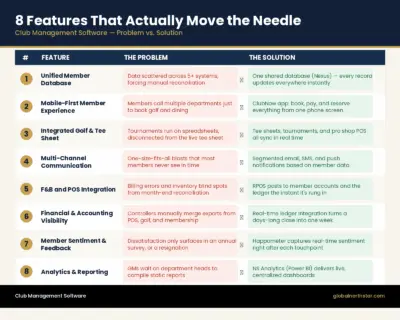
1. A Single, Unified Member Database
Every reservation, invoice, tee time, dining preference, and service request should live in one place, not scattered across five systems that require manual reconciliation. Clubs that consolidate onto a single database consistently report the same outcome: staff spend less time re-entering data and more time serving members, and leadership finally gets reporting they can trust.
This is the difference between a true club operations software platform and a bundle of point solutions wearing the same logo. Fragmented systems force staff to manually sync information between accounting, POS, and membership records, which is exactly the workflow that leading platforms are built to eliminate.
How Does a Single-Database Platform Eliminate Data Silos?
This is what Northstar Nexus was built to solve. Instead of separate systems for back office, staff tools, the member website, and the mobile app, Nexus runs all four on one shared database. So a change made in one place is instantly visible everywhere else.
Real-world scenario: A member calls the front desk to update a family member’s dining allergy notes and ask about their outstanding balance. Because Nexus connects membership, F&B, and accounting on one record, the staff member sees the updated profile, the real-time balance, and the reservation history in a single screen; no transferring the call, no checking a second system, no “let me call you back.” That’s the difference between a true club operations software platform and a bundle of point solutions wearing the same logo.
2. A Mobile-First Member Experience
Members now expect the same convenience from their club that they get from any consumer app: book a tee time, reserve a dining table, check account balances, and pay a bill, all from a phone. A country club technology stack without a strong mobile app is asking a younger, busier membership to work harder than it should to use the club it’s paying for.
What can members actually do from their phones?
This is what the ClubNow, Northstar’s member-facing mobile app, answers. Members use it to book tee times, reserve dining, check event calendars, pay bills, and receive real-time push notifications, all tied directly into the same Nexus database staff are working from.
Real-world scenario: It’s Friday afternoon, and a member decides last-minute to invite two guests for Saturday golf followed by dinner. Instead of calling the pro shop and then calling the dining room separately, they open ClubNow, book the tee time, add their guests, and reserve a table, everything in under two minutes. The golf shop and the dining staff see the same booking instantly.
As one member on this exact workflow put it: “We started with Northstar with their state-of-the-art technology. It’s put us way ahead of what we’ve ever done. Our members now can book courts seven days in advance. They go to the app and they book the courts. They can cancel their reservation, and they could book a tennis lesson, they can book a clinic. And so it makes it easier, more friendly for the members. Compared to a couple years ago, we have new people starting every week. I really thank Northstar for it because I get new ladies and men starting every week and I think they get it through the app.” – Mike Welnitz, Director of Sports, Laredo Country Club.
3. Integrated Golf and Tee Sheet Management
For golf and country clubs specifically, the tee sheet is operational ground zero. When it’s tied directly into point-of-sale and membership rules, rather than bolted on as a separate system, clubs avoid the reporting discrepancies that come from running golf and F&B on different platforms.
How do Golf Clubs keep Tee Sheets and Tournaments in Sync?
Northstar’s Golf & Tee Times module ties directly into ClubNow and the club’s Connect website. So tee sheets, tournament registration, and pro shop POS all draw from the same schedule.
Real-world scenario: A club is running its member-guest tournament, which normally means a spreadsheet for registration, a separate tee sheet, and manual updates to the pro shop when pairings change. With the Tournament Manager, members register and pay through ClubNow, pairings publish directly to the live tee sheet, and any last-minute change automatically notifies affected players and staff, removing the reconciliation step that used to take away a full day of the golf ops team’s week.
4. Multi-Channel Communication that keeps Members engaged
A club’s relationship with a member doesn’t pause the moment they leave the parking lot. Between visits, members still need to hear about a rained-out event, a payment that’s due, or a tournament sign-up deadline, and every member has a different channel they actually pay attention to. Software that can only send one type of message forces every member into the same communication habit, whether it fits them or not.
How Does Multi-Channel Communication Keep Members Engaged Across Email, Text, and Push Notification?
Northstar’s marketing and campaign tools let clubs reach members through email, SMS/text messaging, push notifications, and in-app announcements; all built on the same membership data as the rest of the platform. So, messages can be segmented by membership type, spending habits, interests, or age group rather than blasted to an entire roster at once.
Real-world scenario: A club needs to notify members that Saturday’s outdoor social has been moved indoors due to weather. Instead of one all-member email that half the club won’t see in time, the communications team sends an automated push notification to members already registered for the event, while a broader email update goes out to the full membership list for general awareness. A separate automated reminder triggered directly from the dining reservation module pings members with an upcoming booking in the morning, cutting down on no-shows without anyone on staff manually sending a single message. The result is a member who feels genuinely kept in the loop, not one more name on a mass mailing list.
5. Real Food & Beverage and POS Integration
F&B is often a club’s most complex, highest-volume department, and it’s also where fragmented software causes the most visible friction: slow ticket times, inventory blind spots, and billing errors that erode member trust. Integrated F&B and POS tools that share data with accounting in real time close that gap.
How does Integrated F&B POS prevent billing errors at the grill room?
Northstar’s POS (retail and F&B point-of-sale) posts directly to the member’s account and the general ledger in real time. This eliminates the need to sit in a standalone system that needs to be reconciled at month-end.
Real-world scenario: During a busy Sunday brunch, a server rings in a table’s order on POS. The charge posts immediately to the member’s account, inventory is decremented for every item used. And the transaction is already reflected in the day’s revenue report before the table has finished dessert; instead of showing up as a mismatched batch upload the next morning that the accounting team has to chase down.
6. Financial and Accounting Visibility
Clubs are, at their core, member-owned or member-serving financial operations. Accounting modules that connect directly to membership, POS, and golf activity give CFOs and controllers the ability to close books faster and catch discrepancies before they become member-facing problems. This reduces the reconciling exports from three different systems.
How Does Real-Time Accounting Integration Speed Up Month-End Close?
Northstar’s Club Accounting & Financial Reporting pulls activity directly from membership billing, POS, and golf in real time, rather than requiring a controller to import exports from three disconnected systems.
Real-world scenario: It’s the first week of the month, and the controller needs to close the books. Instead of manually merging POS exports, membership billing reports, and golf revenue into a reconciliation spreadsheet and chasing down whatever doesn’t tie out. The numbers are already aligned because every transaction is posted to the same ledger as it happens. What used to take days of reconciliation becomes a same-week close.
7. Member Sentiment and Feedback Tools
This is an emerging category that’s quickly becoming a differentiator. Clubs are starting to treat member sentiment the way consumer brands treat NPS. As an early warning system for attrition, not a once-a-year survey. Tools that let members flag concerns directly and let staff respond in real time turn retention from reactive to proactive.
How do you catch member dissatisfaction before it becomes a cancellation?
This is exactly what Happometer, Northstar’s AI-powered member feedback tool, is designed to do. It captures real-time sentiment after specific member touchpoints instead of waiting for an annual satisfaction survey.
Real-world scenario: A member has a disappointing dining experience on a Saturday night. Instead of quietly deciding not to renew months later, they get a same-day Happometer prompt, flag the issue, and the GM sees the alert within hours, enabling a personal follow-up before the frustration hardens into a resignation letter.
8. Analytics and Reporting That Leadership Can Actually Use
Boards and GMs don’t need more data; they need the right data, in one dashboard, without a spreadsheet in between. Platforms that centralize reporting across membership, F&B, golf, and accounting give club leadership the ability to make decisions based on what’s actually happening, not what each department believes is happening.
How do GMs make faster decisions with real-time dashboards?
Northstar’s NS Analytics, a Power BI driven analytics module, centralizes reporting across membership, F&B, golf, and accounting into live dashboards. So club leadership isn’t waiting on a department head to compile a static report.
Real-world scenario: A GM walks into a Monday board meeting, and a board member asks how F&B revenue this quarter compares to golf shop revenue, broken down by member segment. Instead of promising to “get back to them” after pulling data from separate systems, the GM opens the Power BI dashboard live in the meeting and has the answer on screen in seconds, turning a follow-up item into an in-the-room decision.
Where Legacy Systems Fall Short?
Much of the club software market today is still built on a “best of breed” model: separate systems for POS, membership, accounting, and golf. These are often stitched together with manual exports or third-party integrations. That approach was standard for years, and many long-tenured platforms in this space still operate this way.
The tradeoff is real: every integration point is a place where data can drift out of sync, and every additional system is another login, another training cycle, and another vendor relationship for an already stretched club staff to manage. A private country club platform built on one database, rather than several connected ones, removes that risk entirely. There’s nothing to sync because there’s nothing to keep separate.
This is also where mobile-first, single-database platforms tend to pull ahead of older, on-premise-rooted systems. They were built for cloud access and continuous updates from day one, rather than retrofitted for it.
What are clubs running on Unified Platforms saying?
The proof point for any club member experience software claim is what actually happens after go-live. A few examples from clubs running Northstar’s integrated platform:
“Northstar helped us move from six different systems that did not speak to each other to one consolidated data platform. This helped us become more efficient and much more effective in serving our members.” — Jesse Ruben, Director of Finance, The Landings Golf & Athletic Club
“The tee time app has been very well received by our members. It is easy to use and has made some significant enhancements to get the members on the course at the times they want and the people they want to play with.” — Ben Hay, CEO, Crane Creek Country Club
Hear from the words of Jennifer Garrott; how the Nexus upgrade is helping them enhance member engagement with faster reservations and food ordering and has made a real difference for the staff.
Northstar Customer Speak – Jennifer Garrott:
Choosing the Right Platform for Your Club
The country club software features that move the needle all share one thing in common. They reduce the number of data places data to live, and the number of steps a member or staffer has to take to get something done. Before evaluating vendors, it’s worth mapping your current stack against a simple question: how many systems does a single member interaction actually touch today?
If the answer is more than one, that’s the gap worth closing first.
Want to see what a fully unified platform looks like for your club?
Request a demo with Northstar to walk through membership, golf, F&B, accounting, and member engagement, all running on a single database, built specifically for private and country clubs.