



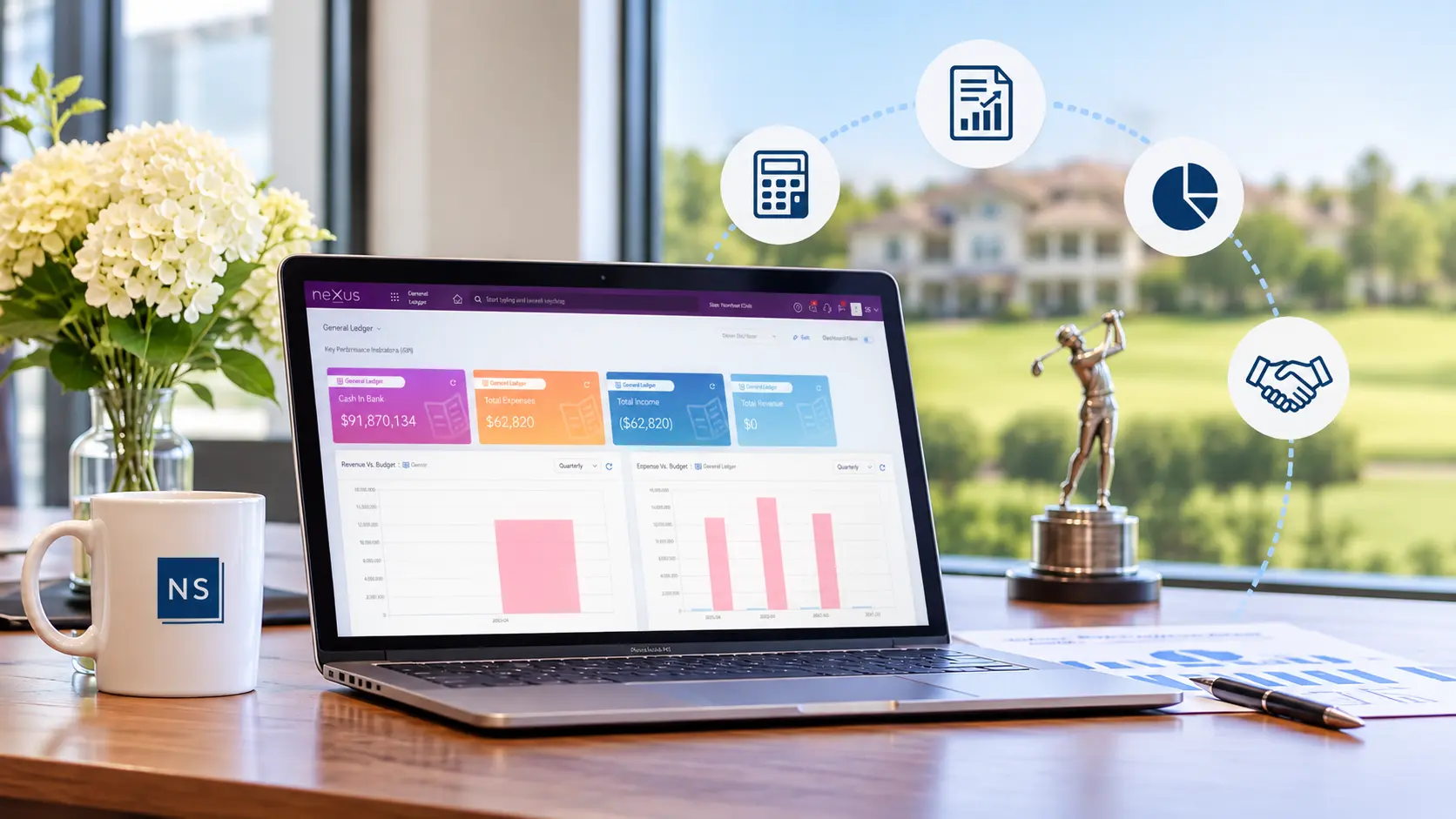
Running a private golf or country club means operating multiple distinct business units under one roof. On any given weekend, leadership oversees an agronomy operation, a hospitality dining program, a retail pro shop, private banquets, and a subscription membership collective.
Yet, many General Managers, Controllers, and Board Treasurers still run these multifaceted enterprises on legacy accounting tools and disconnected spreadsheets. The result is familiar across the industry: a grueling month-end close, blind spots across key revenue centers, and board meetings spent defending historical numbers instead of executing strategic capital plans.
Modern club financial reporting software eliminates this friction. By uniting general ledger operations, point-of-sale (POS) systems, member accounts, and departmental budgets into a single source of financial truth, purpose-built golf club financial management software gives leadership real-time visibility to protect operating margins and reinvest in member value.
Here is how modern clubs are transforming their back office into a strategic growth engine and what leadership teams need to evaluate when upgrading their financial stack.
The Hidden Cost of Outdated Club Accounting Software
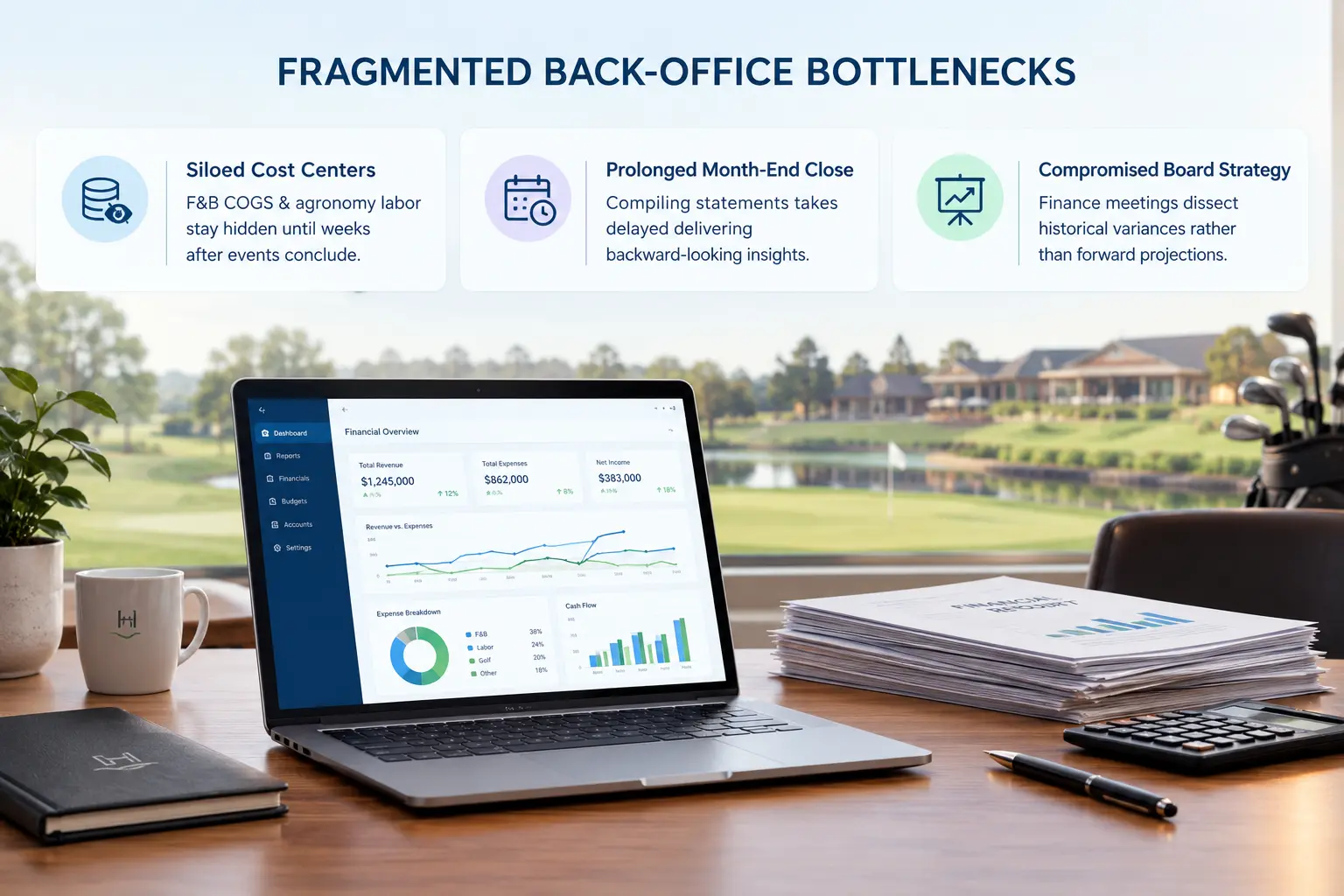
Traditional accounting workflows rely heavily on manual journal entries and batch exports. When pro shop retail, dining room POS, membership records, and tee sheets live on separate islands, the finance team spends 80% of its working hours reconciling data and only 20% analyzing it.
Operational pain points that trigger the need for modern club financial management software include:
- Siloed Departmental Data: The Food & Beverage (F&B) Director cannot evaluate the actual cost of goods sold (COGS) until weeks after an event, leading to cost overruns on banquets.
- Prolonged Month-End Close: When compiling financial statements takes until the third week of the following month, boardroom decisions are based on stale data.
- Manual Entry Errors: Transferring records across CSV files increases reconciliation discrepancies between member accounts receivable (AR) and bank deposits.
- Capital Reserve Uncertainty: Clubs struggle to accurately separate initiation-fee capital reserves from daily operational cash flow, complicating long-term asset planning.
According to research highlighted in the GCMA Software & Technology Landscape Report, clubs operating on fragmented software stacks lose dozens of administrative hours each month solely to cross-platform data hygiene. Industry analyses emphasize that modernizing club financial visibility systems is a baseline governance necessity.
How does Northstar Accounting Software help streamline club accounting operations?
Private club finances rarely fit into standard commercial ERPs without heavy manual workarounds. Complex membership hierarchies, food-and-beverage minimums, reciprocal billing, and departmental cost centers often leave finance teams reconciling spreadsheets rather than guiding strategy.
Northstar Club Accounting Software addresses these challenges with a single-database platform purpose-built for private clubs, giving General Managers, Chief Financial Officers, and Controllers automated workflows, tighter internal controls, and real-time operational visibility.
Accounts Receivable:
- Eliminate administrative overhead by automatically calculating member F&B minimums, dues, assessments, and late fees according to your custom profile rules.
- Accelerate cash flow and reduce DSO through flexible split-receivables, digital or print statement delivery, and seamless automated ACH/credit card payments.
- Gain immediate billing transparency by automatically syncing pro shop, dining, and activity charges straight to member folios in real time.
Accounts Payable:
- Prevent overpayment and billing discrepancies with automated 3-way matching that links invoices directly to receiving slips.
- Simplify inter-club billing by routing reciprocal charges directly to member accounts without manual journal entries.
- Optimize working capital by automating vendor payment terms, capturing early-payment cash discounts, amortizing prepaid expenses, and simplifying bank reconciliations.
General Ledger & Budgeting:
- Maintain complete financial control across your entire operation with a centralized, club-specific chart of accounts, multi-department allocation journals, and recurring accruals.
- Make faster, data-driven decisions using built-in budget modeling with bi-directional spreadsheet import/export for instant variance tracking.
Financial Report Designer:
- Empower your finance team to create polished, board-ready P&Ls and balance sheets independently using an intuitive, Excel-like report builder.
- Enhance operational accountability by delivering department-specific, role-restricted financial updates straight to department heads’ desktops.
- Drastically compress your month-end close cycle to hours by seamlessly pulling real-time ledger data.
Timekeeping & Payroll:
- Control labor expenditures by linking POS terminals directly to timecards, providing immediate visibility into clocked-in staff across all outlets.
- Ensure payroll accuracy and compliance across specialized club roles by effortlessly managing overtime, premium pay rates, and split-schedules.
- Save administrative time and prevent re-entry errors by exporting pre-formatted data directly to major payroll providers.

Club Financial Reporting vs Club Accounting Software: What Is the Difference?
While often delivered within a unified platform, understanding the distinction between accounting and reporting helps clubs pinpoint their operational gaps.
| Operational Dimension | Golf Club Accounting Software | Club Financial Reporting Software |
| Primary Role | Transactional engine (GL, AP, AR) | Analytical and strategic layer |
| Architecture | Multi-entity & departmental chart of accounts | Real-time executive dashboards & data feeds |
| Core Functions | Bank reconciliations, dues billing, audit logs | Board report packets, scenario forecasting, KPIs |
| Industry Standard | Adherence to Uniform System of Financial Reporting for Clubs (USFRC) guidelines | Trend benchmarking and variance analysis |
In short, a Golf Club Accounting Software serves as the core transactional engine. It manages the general ledger, accounts payable, dues and minimums billing, chart of accounts customized to the Uniform System of Financial Reporting for Clubs (USFRC), and audit trails. Whereas a Club Financial Reporting Software represents the analytical layer sitting atop operational data. It transforms raw transactions into drill-down financial dashboards, multi-year capital forecasting models, departmental P&L views, and standardized board presentation packages.
Core Capabilities of Modern Club Financial Visibility Platforms
When evaluating the accounting & financial reporting software designed for modern private and semi-private clubs, ensure the solution delivers these foundational capabilities:
1. Departmental P&L Visibility
A modern club is not a single profit center. Specialized platforms provide automated departmental accounting across:
By organizing financial tracking around distinct revenue centers—including Golf Operations & Pro Shop Retail, Agronomy & Course Maintenance, Food & Beverage (À la carte, Banquets, Beverage Carts), Membership & Initiation Dues, Tennis, Fitness, and Aquatics, Marina & Yacht, as well as Rooms & Events—leadership gains clear, real-time control over every aspect of club performance.
Department heads access restricted, live views of their actual vs. budget performance without viewing sensitive club-wide compensation or balance sheet metrics.
2. Native System Integrations (POS, Tee Sheets, Payroll)
Manual exports invite friction. A true single-database platform connects directly with front-of-house touchpoints:
- Point-of-Sale (F&B and Retail): Member charges, service fees, and inventory reductions post directly to the general ledger and member folio.
- Tee Sheet & Reservations: Rounds played sync with green fee revenue, guest packages, and member utilization metrics.
- Payroll Processing: Labor allocations across agronomy, culinary, and outside service teams sync with labor cost reporting.
3. Automated Board-Ready Reporting & Dynamic Dashboards
Instead of manually copying figures into static slide decks, modern reporting tools generate automated, branded financial packets tailored for board review. Treasurers and finance committees can review trends through role-based dashboards that showcase live liquidity, debt service coverage, and capital reserve balances.
To evaluate operational software and modernize reporting workflows, club managers can review dedicated decision frameworks published by industry specialists:
Benchmarking & Financial KPIs: Measuring What Matters
High-performing clubs do not manage solely to top-line revenue; they manage against targeted operational ratios and industry benchmarks.
Industry guidance from recent CMAA Board Brief Insights emphasizes that healthy clubs maintain clear separation between operating capital such as dues, usage fees, F&B, and capital improvement reserves such as initiation fees and capital assessments.
Modern club reporting software tracks these vital metrics automatically:
- Dues-to-Operating-Revenue Ratio: Measures the stability of fixed revenue against variable income fluctuations (e.g., weather-impacted guest fees or banquets).
- F&B Cost of Sales Percentage: Segregates food costs from beverage costs in real time to catch purchasing creep before margins compress.
- Labor Cost as a Percentage of Revenue: Correlates labor scheduling against daily member activity and covers.
- DSO (Days Sales Outstanding) & Member Aging: Keeps accounts receivable under control with automated statement delivery and self-service member payment portals.

Explore – What is Club Accounting Software – A Complete Guide for Private and Country Clubs
Immediate Operational Wins for the Club Back Office
Implementing purpose-built club accounting software drives tangible business returns within the first full accounting cycle:
1. Compress Month-End Close
With automated bank reconciliation, integrated POS batch feeds, and pre-scheduled depreciation, finance teams eliminate the end-of-month scramble. Club Controllers transition from manual data scrubbers to forward-looking strategic advisors.
2. Departmental Accountability for Directors
When your Course Superintendent or Head Golf Professional can log in from a tablet and see their real-time budget burn rate, they make informed decisions on maintenance supplies or pro shop merchandise, preventing unbudgeted year-end surprises.
3. Strengthen Board Governance and Continuity
Club boards turn over frequently. Static spreadsheets stored on individual local hard drives leave clubs vulnerable to institutional memory loss. Centralized cloud platforms ensure historical figures, vendor agreements, capital replacement reserves, and audit logs remain accessible to new committees.
Club Reporting & Accounting Software Selection Checklist
Before committing to a club accounting and reporting software, ensure your finance committee evaluates vendors against these requirements:
| Evaluation Criteria | What to Look For | Why It Matters |
| USFRC Compliance | A system pre-configured with the Uniform System of Financial Reporting for Clubs chart of accounts. | Ensures consistent financial classification and reporting aligned with private club accounting practices. |
| Single-Database Architecture | Native integration between accounting, POS, tee sheets, and member accounts without relying on third-party middleware. | Eliminates data silos, reduces manual reconciliation, and improves financial accuracy. |
| Configurable Financial Report Designer | Built-in tools to create, customize, preview, and export P&L statements and balance sheets. | Gives finance teams flexibility to generate reports that meet their club’s specific reporting requirements. |
| Granular Role-Based Permissions | Customizable access controls for Board Members, General Managers, Department Heads, and Staff Accountants. | Protects sensitive financial information while ensuring stakeholders have access to relevant data. |
| Dedicated Club Onboarding | An implementation team experienced in club-specific accounting requirements, including food minimums, dues structures, and initiation fee accounting. | Prevents implementation delays and ensures complex club billing rules, deferred revenue, and assessments are mapped correctly from day one. |
The right club accounting software should do more than manage financial transactions. It should support club-specific accounting requirements, integrate financial data across departments, simplify reporting, and provide leadership with better control over financial operations.
Upgrade Your Club’s Financial Operations
Manual reconciliations, delayed financial packages, and blind spending decisions hold golf clubs back from reaching their full operational potential. Modernizing your accounting and reporting technology empowers your leadership team to protect operating cash flow, elevate the member experience, and make data-backed investments in your club’s future.
Explore how an integrated platform unifies your club’s back office:
Learn more about integrated back-office systems via Northstar Club Accounting & Back Office Solutions.
Book a Platform Walkthrough: Discover how unified software eliminates manual close friction by exploring the Northstar Club Management Platform.
Frequently Asked Questions
What is club financial reporting software?
Club financial reporting software is an analytics and reporting system tailored to private clubs, golf resorts, and member communities. It consolidates financial data across all operating departments (golf, dining, retail, maintenance) into real-time dashboards, departmental P&L statements, and board-ready financial packages.
What is club accounting software?
Club accounting software is the underlying transactional platform managing the general ledger, accounts payable, accounts receivable, dues billing, member spending minimums, and asset depreciation. It is built to support the Uniform System of Financial Reporting for Clubs (USFRC).
How does specialized accounting software help golf clubs, country clubs & private clubs?
It replaces fragmented point solutions and spreadsheets with an integrated database. By automating recurring member dues billing, syncing POS transactions in real time, and unifying inventory management, it reduces human error, shortens month-end close times, and protects operating margins.
What financial reports should a club track monthly?
A golf club should review departmental P&L statements (separating Golf, F&B, Maintenance, and Admin), a consolidated Balance Sheet with designated capital reserves, Accounts Receivable Aging reports, Labor Cost as a % of Revenue, and an Actual vs. Budget Variance report.
Can club accounting software integrate with existing POS and membership systems?
Yes. Modern club software platforms are built with unified databases or open APIs that integrate directly with point-of-sale terminals, tee sheet engines, member mobile apps, and payroll providers, ensuring clean two-way data flow without manual batch imports.